
Picture a bone spur or a slipped disc leaning on the spinal cord. That’s compression. The first things you notice are small: a coin that won’t stay in your fingers, a staircase that suddenly needs the rail. They creep in so slowly that people blame age, and Johns Hopkins notes that’s exactly how diagnosis gets delayed. The cord is the main cable between brain and body. Pressure on it is not something to wait out.
According to Dr. Guruprasad Hosurkar, a Neurologist in Bangalore, spinal cord compression assessment: “Dropping coins and fumbling shirt buttons are the signs patients laugh off. In the neck, those are exactly the ones I want to hear about.”
Fumbling buttons or dropping things lately?
How Does Spinal Cord Compression First Show Up?
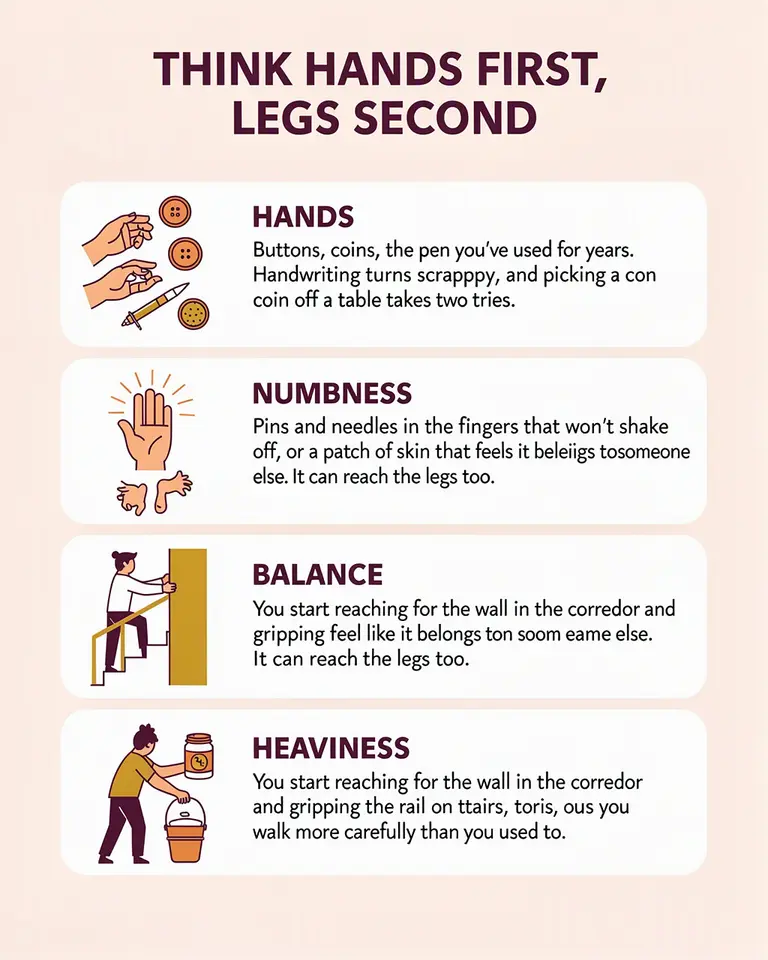
Weakness that climbs up from the feet over days is a different emergency, covered under Guillain-Barré syndrome treatment.
When Is Spinal Cord Compression an Emergency?
Most cases creep. A few don’t.
Bladder or bowel: Suddenly can’t hold on, or can’t tell when you need to go. That’s a red flag, and it means the emergency room today.
Speed: Usually it builds over months. Now and then it turns up fast, and a slipped disc is the classic reason.
Walking: Unsteadiness that is growing, week by week.
Combination: Clumsy hands plus a changed walk plus numbness is the pattern that shouldn’t wait for an appointment next month.
Not sure whether what you have counts as an emergency? Neurological emergencies and signs you need the ER has the rest of the list.
What Happens Once Spinal Cord Compression Is Suspected?
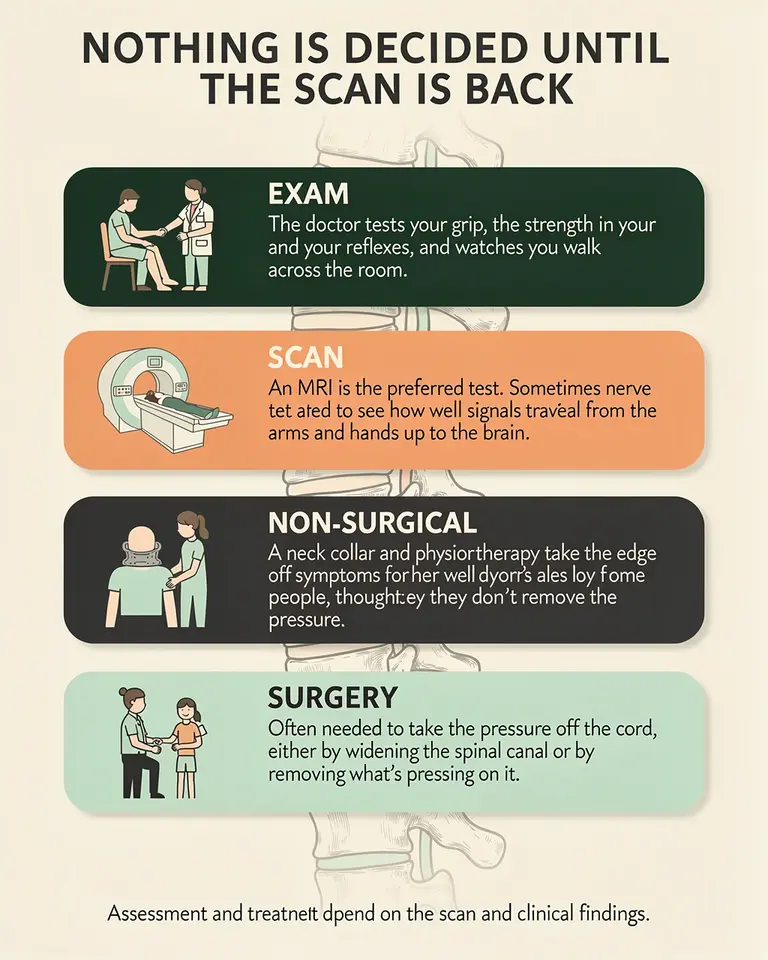
Because the symptoms pass for ordinary ageing, diagnosis tends to come late, and earlier diagnosis gives better results, so persistent tingling in the hands and feet is worth getting checked.
Key Takeaways
- Early on it’s clumsy hands, numb fingers and a walk you’ve started to watch.
- Neck pain is not required. Some people have none.
- Sudden bladder or bowel trouble, or weakness that’s getting worse fast, means the emergency room, not a clinic booking.
- An MRI finds it, and surgery is often how the pressure comes off.
- Earlier diagnosis gives better results, so don’t put it down to age
FAQ
What usually squeezes the spinal cord?
Mostly a worn spine: age-related changes, slipped discs and bone spurs. Injury, infection and tumours are the rarer causes.
Can spinal cord compression happen without neck pain?
Yes. Some people have no neck pain at all.
Which test confirms spinal cord compression?
An MRI is the preferred scan, usually after an exam of strength and reflexes.
Does spinal cord compression need surgery?
Often, to relieve the pressure and stop it worsening, though physiotherapy and a neck collar help some people.