
Yoga doesn’t slow Parkinson’s underlying neurodegeneration, but it does measurably improve motor symptoms, balance, and quality of life when combined with standard treatment. The benefit comes from better flexibility and reduced rigidity, not any effect on dopamine-producing neurons. Regular practice eases daily symptoms and lowers fall risk, but it doesn’t change the disease’s course.
According to Dr. Guruprasad Hosurkar, Parkinson’s disease specialist, “Yoga won’t replace medication or DBS, but it consistently helps patients move better and fall less.”
Wondering how yoga fits into your Parkinson’s treatment plan?
What Does Research Actually Show About Yoga and Parkinson's?
Several randomized trials have tested yoga specifically in Parkinson’s patients, not just general exercise.
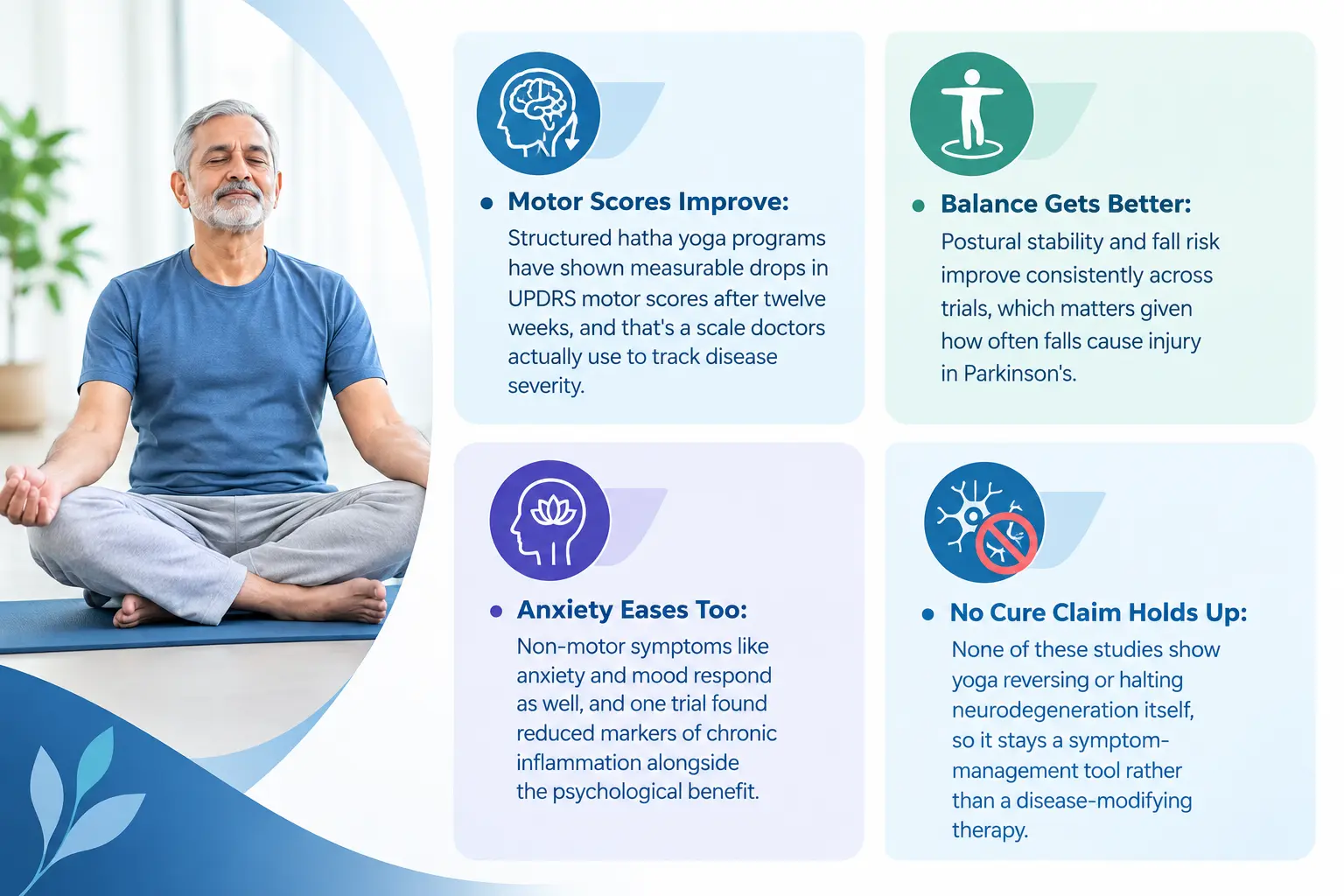
These gains come from regular practice, not occasional sessions. Most neurologists fold yoga into a broader movement-disorder treatment plan rather than prescribing it alone.
How Should Someone With Parkinson's Actually Practice Yoga Safely?
Not every yoga style suits every stage of Parkinson’s, and getting this wrong raises fall risk instead of lowering it.
Chair-Based Options: Patients with significant balance trouble often start with chair yoga, keeping the stretching and breathing benefits without the standing-balance risk.
Supervised Classes Matter: A PD-aware instructor, or someone trained in adapting poses, catches compensations that a general class would miss entirely.
Timing Around Medication: Practicing during the “on” phase of levodopa, when movement is smoothest, gets far more out of a session than pushing through an “off” period.
Consistency Over Intensity: Twice-weekly sessions sustained for months outperform occasional intense classes; most positive trial data reflects programs run eight to twelve weeks minimum.
Yoga works best as one piece of a broader routine. Our guide to structured exercise for Parkinson’s covers how it fits alongside walking, strength work, and balance training.
Why Choose Dr. Guruprasad Hosurkar?
Dr. Guruprasad Hosurkar leads the Movement Disorders and Parkinson’s Disease Programme at KIMS Hospital, Mahadevapura, with over 22 years of neurology experience and specialised DBS training from Germany. His care model coordinates medication, physiotherapy and speech therapy, and lifestyle work like yoga rather than treating each as a separate track.
One patient’s tremor barely responded to an early yoga-only approach tried elsewhere. After proper medication titration alongside a structured practice, her balance scores improved within two months. Yoga helps most when it supplements treatment, not when it replaces it.
FAQ
Can yoga replace Parkinson's medication?
No, yoga supports treatment but doesn’t replace medication or surgery.
Is yoga safe in advanced Parkinson's?
Often yes with modifications, but supervision matters more as balance declines.
How soon can yoga show benefits?
Some trials report measurable improvement within eight to twelve weeks.
Which yoga style works best for Parkinson's?
Hatha and chair-based yoga have the most supporting research.