
Deep brain stimulation (DBS) is one of the most effective long-term options for advanced Parkinson’s disease, but patients considering it often ask the same thing: will it still help a decade from now? Dr. Guruprasad Hosurkar, a leading neurologist in Bangalore, breaks down what long-term clinical data actually shows, using simple visuals instead of dense medical jargon.
“Patients often assume DBS either works forever or stops working entirely. The real picture is more nuanced, and understanding it helps set the right expectations from day one.” — Dr. Guruprasad Hosurkar
Considering DBS surgery for Parkinson’s, or want to understand how your existing implant may perform long-term?
The target you choose matters more than you’d think
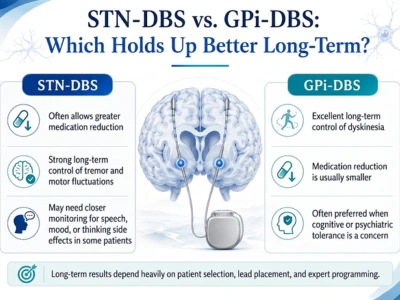
STN-DBS vs. GPi-DBS: Which Holds Up Better Long-Term?
Not all DBS surgery targets the same part of the brain. The two most common targets, the subthalamic nucleus (STN) and the globus pallidus interna (GPi), differ in how long their benefits last and how they affect medication needs.
For most patients on high medication doses with fluctuating symptoms, STN is the more commonly chosen target. GPi may be preferred for those more sensitive to mood or cognitive side effects.
Here’s what actually happens to your pill count
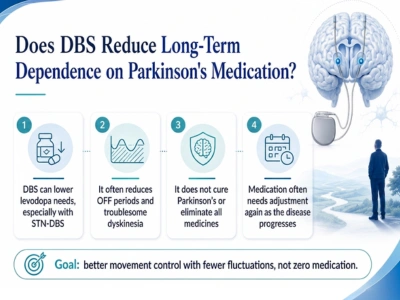
Does DBS Reduce Long-Term Dependence on Parkinson's Medication?
DBS doesn’t eliminate the need for Parkinson’s medication, but most patients see a meaningful and lasting drop in their levodopa requirement, and that drop tends to hold for years, not months.
This matters because lower medication doses usually mean fewer dyskinesia episodes and more predictable “on” periods throughout the day.
Curious how much your medication dose could realistically change after DBS?
The part nobody likes talking about, but should
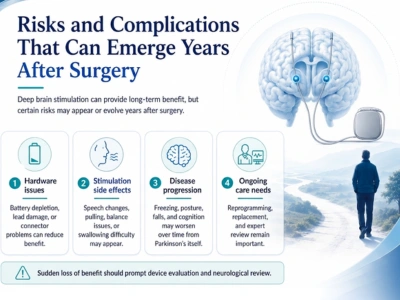
Risks and Complications That Can Emerge Years After Surgery
DBS is a well-established procedure, but like any implanted device, it carries risks that can surface well after the initial surgery, not just in the first few weeks.
None of these risks are common enough to be a reason to avoid DBS, but they’re exactly why routine follow-up with a movement disorder specialist matters years after surgery, not just in year one.
Turns out 10 years wasn’t the ceiling after all
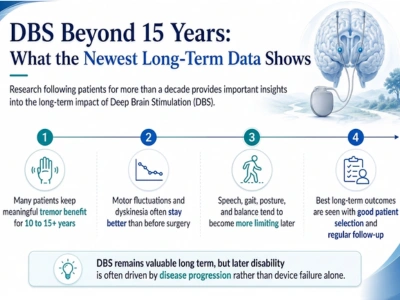
DBS Beyond 15 Years: What the Newest Long-Term Data Shows
Older assumptions suggested DBS benefits faded sharply after 10 years. Newer cohort studies are pushing that timeline further out.
This doesn’t mean the benefit stays as strong as year one, it gradually tapers, but “still working” 15 years on is now backed by real follow-up data, not just theory.
Had DBS surgery years ago and not sure if it’s still performing the way it should?
Cutting through the noise: here’s what matters
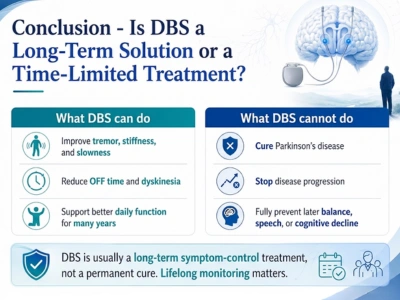
Conclusion — Is DBS a Long-Term Solution or a Time-Limited Treatment?
DBS is best understood as durable symptom management, not a cure and not a treatment with a fixed expiry date. Tremor and rigidity control tend to hold up well for over a decade, medication needs usually stay lower long-term, and even symptoms that fade are typically tied to disease progression rather than device failure. For most patients, that trade-off remains worthwhile well past the 10-year mark.
Still have questions about how DBS surgery for Parkinson’s may hold up for your specific case? Dr. Guruprasad Hosurkar, neurologist in Bangalore, can walk you through what to expect based on your current symptoms and disease stage.
FAQs
Does DBS stop working after 10 years?
No. Motor benefits typically persist for 10 years and beyond, though the degree of improvement gradually decreases compared to the first few years after surgery.
How long does the "DBS honeymoon phase" last?
Roughly the first three years after surgery, when patients usually see the most noticeable improvement in both motor and non-motor symptoms.
What symptoms does DBS help with the most, long term?
Tremor and rigidity tend to respond best over the long term. Gait, balance, and speech are more likely to change over time due to disease progression rather than the device itself.
Is DBS still effective for patients over 75?
Yes. Studies in older patients have shown continued improvement in motor function, daily activity levels, and quality of life, with safety profiles comparable to younger patients.
Can a second DBS surgery be done if the first stops helping?
In select cases, yes. This may involve lead revision, target adjustment, or battery/device replacement, depending on why the original benefit has reduced. A movement disorder specialist can assess whether this is appropriate.