
Normal pressure hydrocephalus (NPH) is what happens when cerebrospinal fluid collects inside the brain instead of draining away, and it mostly turns up in the elderly. Those swollen chambers lean on the tissue around them. Three things show up together: a shuffling walk, a bladder that won’t wait, and thinking that has slowed down. Families put it down to old age. Doctors mix it up with Alzheimer’s or Parkinson’s all the time, which is a shame, since this is one of the few that can actually be treated.
According to Dr. Guruprasad Hosurkar, a Neurologist in Bangalore, “If grandpa walks like his shoes are glued down and has started having accidents, get him checked before anyone says it’s just age.”
Seen a parent’s walking get slower and stuck lately?
What Does NPH Look Like at Home?

Honestly, the walk is what gives it away, since memory loss alone doesn’t make feet stick. The overlap with freezing of gait is a good example of why it gets confused.
How Do Doctors Find and Fix NPH?
First comes the story, then a walking test: watch the person cross the room and turn around.
Brain Scan: MRI or CT shows swollen fluid chambers, but a scan alone proves nothing. It’s read alongside the walk and the history.
Tap Test. A little fluid is drawn through a needle in the lower back, and the neurologist sees whether the shuffle eases a few hours later. For some people it does, quite visibly.
Shunt: the fix, per NINDS, is a thin tube placed by a surgeon to drain the extra fluid. It needs checking now and then, as any tube can clog.
Timing: catch it early and recovery is likelier. Leave it and things slide.
Mind you, plenty of shuffling feet have nothing to do with NPH, so other causes get ruled out first.
The same question of what’s ageing and what isn’t is covered in normal ageing and early dementia.
When Should You Push for a Neurologist, Not Wait and See?
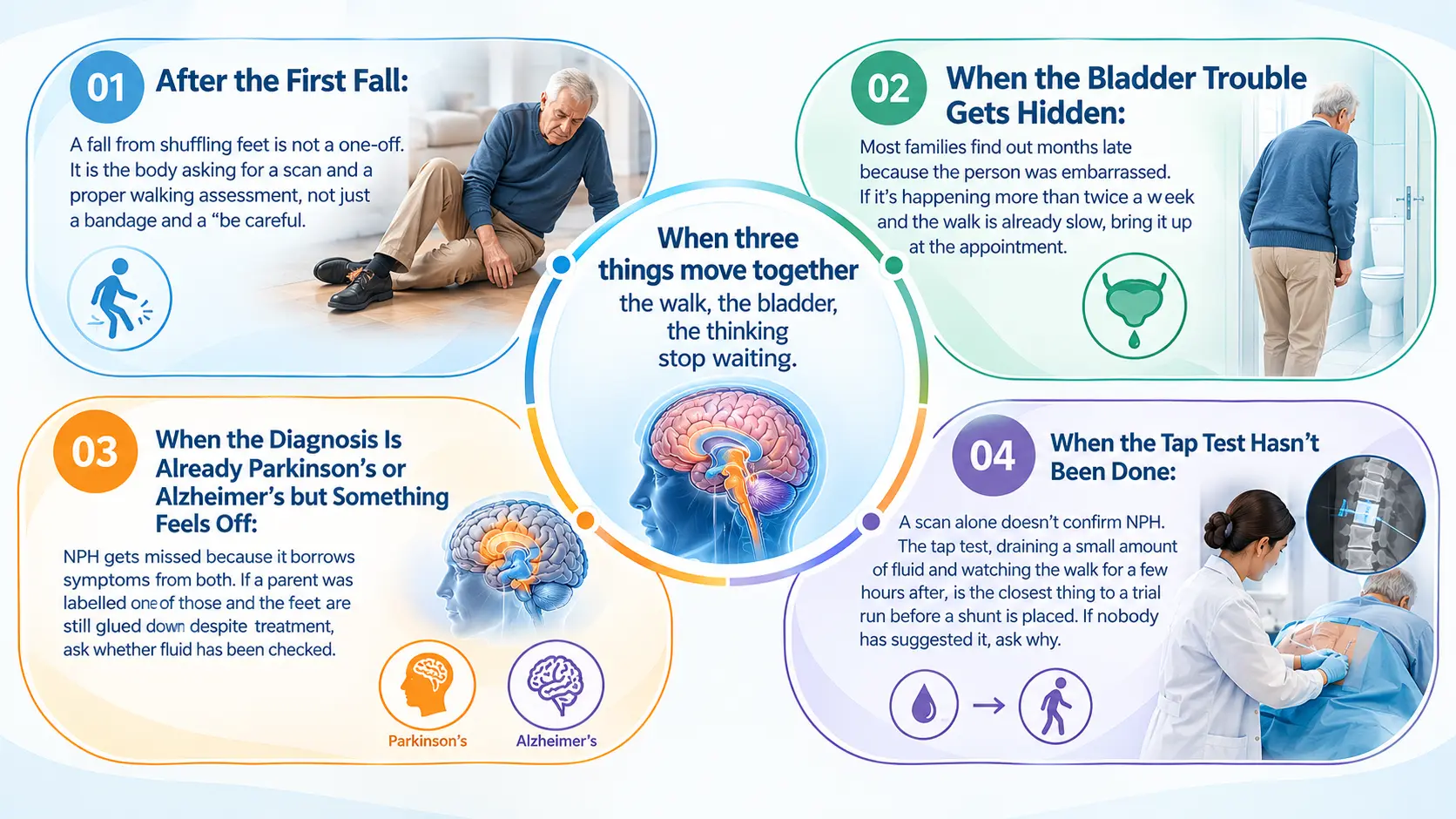
The same stuck-feet pattern in someone already diagnosed with Parkinson’s is covered in detail in freezing of gait in Parkinson’s disease.
Key Takeaways
- NPH collects fluid inside the brain’s chambers and presses on surrounding tissue; the cause is mechanical, not degenerative, which is why it can be treated.
- The classic trio is a shuffling walk with wide steps, sudden bladder urgency, and slow thinking. The walk usually shows first.
- It is routinely confused with Alzheimer’s and Parkinson’s. If those diagnoses aren’t responding to treatment, NPH deserves a look.
- The tap test, not the scan alone, is what tells a neurologist whether a shunt is likely to help.
- The earlier referral, the better the chance of meaningful recovery after a shunt.
FAQ
Is normal pressure hydrocephalus the same as dementia?
Not quite. It mimics dementia, but this one can sometimes be treated.
Can normal pressure hydrocephalus be cured?
A shunt drains the extra fluid, and catching it early gives the best chance of recovery.
How is normal pressure hydrocephalus different from Parkinson's disease?
Both slow walking, but NPH adds bladder trouble and swollen fluid chambers on a scan.
Who gets normal pressure hydrocephalus?
Mostly older people. Head injury, bleeding on the brain or infection can bring it on too.