Parkinson’s disease is a progressive neurological condition that affects movement due to changes in brain areas responsible for controlling coordination. Tremors are one of the common symptoms, which may affect daily activities such as writing, eating, walking, and performing routine tasks. While medicines can help many patients, some may require advanced treatment options when symptoms become difficult to control.
Dr. Guruprasad Hosurkar, a well-known neurologist in Bangalore, explains that advanced therapies should be considered based on symptom severity, medication response, overall health, and individual treatment goals. Proper evaluation helps determine whether options like Deep Brain Stimulation treatment or focused ultrasound are suitable.
With extensive experience in managing movement disorders, Dr. Guruprasad Hosurkar provides specialized care for patients seeking Parkinson’s disease treatment in Bangalore. As a specialist evaluating DBS vs Focused Ultrasound for Parkinson’s Tremor, he focuses on understanding each patient’s symptoms, treatment response, and health condition to recommend an appropriate approach for better movement control and improved daily functioning.
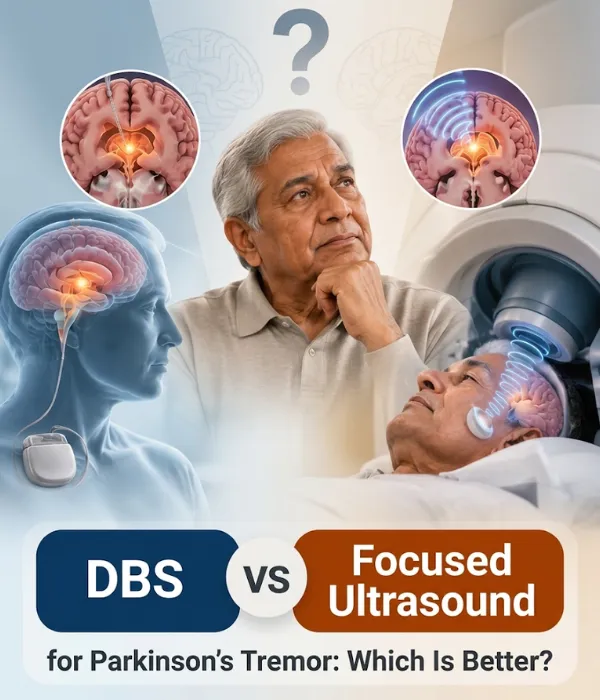
Not sure whether your symptoms can wait for a video visit?
Wondering how DBS helps control Parkinson’s symptoms? Let’s explore how this advanced therapy works and when it may be recommended
What Is Deep Brain Stimulation (DBS) for Parkinson’s Disease?
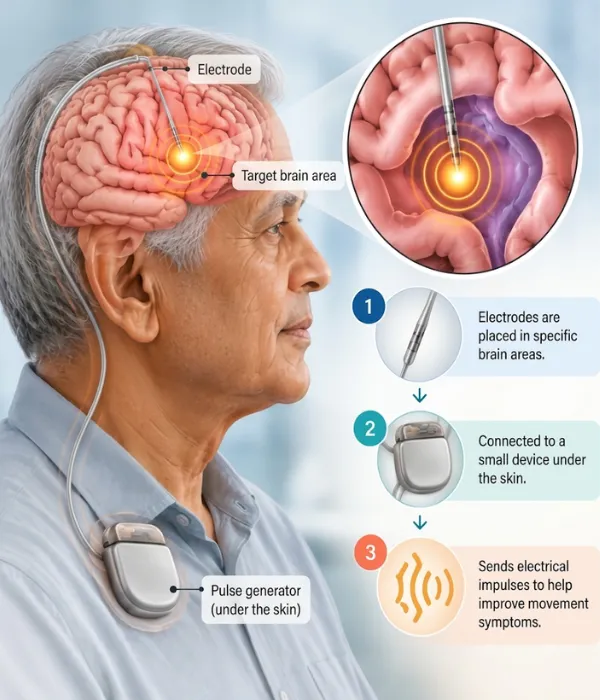
Deep Brain Stimulation for Parkinson’s is an advanced surgical treatment that uses electrical stimulation to regulate abnormal brain activity linked with movement problems. During the procedure, thin electrodes are placed in specific areas of the brain and connected to a small device placed under the skin.
The device sends controlled electrical impulses that help improve movement-related symptoms.
DBS may help manage:
- Parkinson’s tremors
- Stiffness
- Slowness of movement
- Medication fluctuations
- Dyskinesia (involuntary movements)
“DBS does not cure Parkinson’s disease, but it can provide better symptom control for selected patients”, highlights Dr. Guruprasad Hosurkar, an eminent movement disorder specialist in Bangalore. “It is usually considered when medications are no longer providing consistent relief or when side effects become difficult to manage”, he adds.
Factors considered before DBS include:
- Response to Parkinson’s medications
- Duration and severity of symptoms
- Overall health condition
- Brain imaging and neurological assessment
Looking for a non-invasive option for tremor control? Let’s discover how focused ultrasound works for Parkinson’s tremor
What Is Focused Ultrasound for Parkinson’s Tremor?
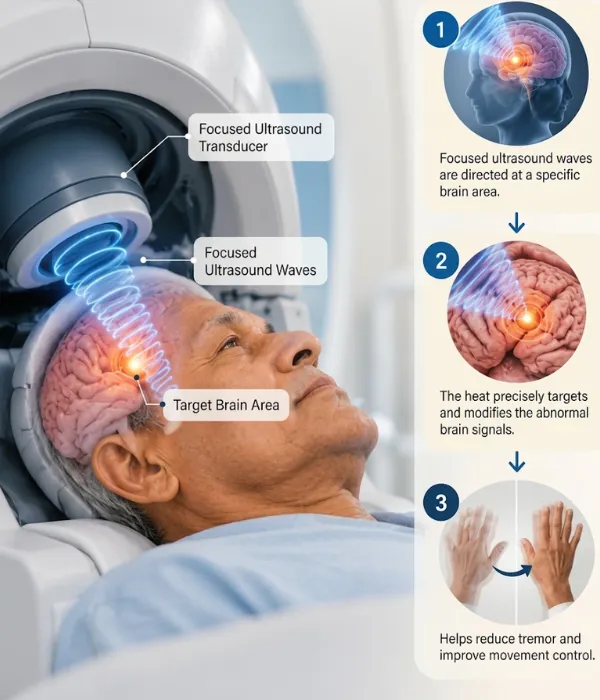
Focused ultrasound is a newer treatment approach that uses concentrated sound waves to create a small, targeted lesion in a specific brain area involved in tremor control. The procedure does not require surgical incisions or implanted devices.
During the procedure:
- MRI guidance helps identify the treatment area.
- Ultrasound waves are focused precisely on the targeted region.
- Heat generated from the ultrasound creates a controlled treatment effect.
Focused ultrasound for Parkinson’s tremor is mainly used for patients with medication-resistant tremors. It may help reduce tremor severity and improve daily functioning.
However, focused ultrasound has certain limitations:
- It is usually performed on one side of the brain.
- It may not be suitable for all Parkinson’s symptoms.
- Patient selection plays an important role in treatment outcomes.
Understanding available treatment options can help in making informed decisions. Connect with an expert to explore suitable tremor management approaches.
How are DBS and focused ultrasound different? Let’s compare these advanced treatments for Parkinson’s tremor
DBS vs Focused Ultrasound: Key Differences
Deep Brain Stimulation (DBS) and focused ultrasound differ in their procedure, technology, treatment approach, and long-term management. The table below compares the key differences between these two options for Parkinson’s tremor treatment.
Feature | Deep Brain Stimulation (DBS) | Focused Ultrasound |
Procedure type | Surgical procedure with implanted device | Non-invasive procedure using ultrasound waves |
Implant required | Yes | No |
Target area adjustment | Stimulation settings can be adjusted | Treatment effect is permanent |
Treatment coverage | Can address multiple movement symptoms | Mainly used for tremor control |
Reversibility | Device can be adjusted or removed | Lesion created is permanent |
Side treatment | Can treat symptoms on both sides in selected cases | Often limited to one side |
Recovery | Requires surgical recovery period | Usually shorter recovery period |
DBS may provide broader symptom control, especially for patients experiencing multiple Parkinson’s symptoms. Focused ultrasound may be considered for selected patients mainly dealing with medication-resistant tremors.
The choice between DBS vs focused ultrasound depends on the patient’s condition, treatment goals, and specialist evaluation.
What benefits can these advanced treatments offer? Let’s explore how DBS and focused ultrasound may help manage Parkinson’s tremor.
Benefits of Deep Brain Stimulation & Focused Ultrasound for Parkinson’s Tremor
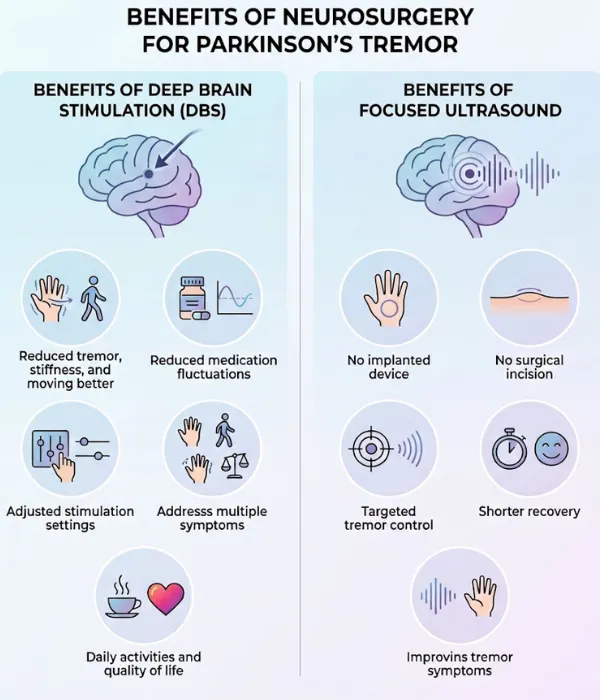
Benefits of Deep Brain Stimulation (DBS)
- Helps reduce tremors, stiffness, and movement difficulties
- May reduce medication-related fluctuations
- Allows adjustment of stimulation settings after treatment
- Can address multiple movement symptoms in suitable patients
- May improve daily activities and quality of life
Benefits of Focused Ultrasound
- No implanted device required
- No surgical incision
- Provides targeted treatment for tremor control
- Usually involves shorter recovery compared to surgery
- May improve tremor symptoms in selected patients
Both treatments have specific advantages and limitations. A detailed neurological evaluation helps identify which option aligns better with the patient’s symptoms.
Which option may be better for Parkinson’s tremor? Let’s understand the factors that influence treatment selection
DBS or Focused Ultrasound: Which Treatment Is Right for Parkinson’s Tremor?
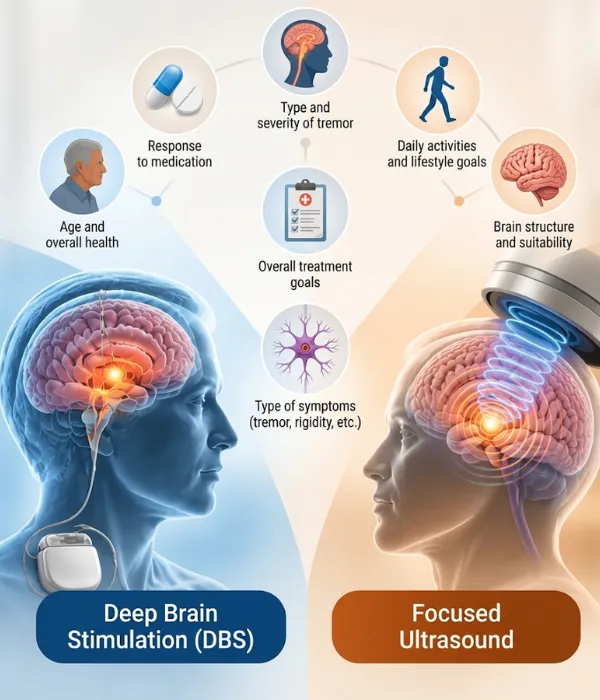
There is no single treatment that suits every patient. The choice between DBS and focused ultrasound depends on several factors, including:
- Severity of Symptoms
Patients with severe tremors, medication fluctuations, or multiple movement symptoms may benefit from DBS evaluation.
- Treatment Goals
Focused ultrasound may be suitable for patients mainly affected by tremors, while DBS may provide broader symptom management.
- Overall Health
Age, medical conditions, and ability to undergo surgery are considered before recommending advanced procedures.
- Parkinson’s Disease Stage
The stage of disease, medication response, and symptom pattern help determine the appropriate treatment approach.
Dr. Guruprasad Hosurkar, one of the best neurologist in Bangalore with expertise in movement disorders can evaluate these factors and suggest suitable options. He focuses on comprehensive assessment and personalized treatment planning for patients with Parkinson’s disease and movement disorders.
Finding the right treatment approach can make a difference in symptom management. Speak with a specialist to understand the most suitable option for your condition.
FAQ
1. Is focused ultrasound safer than DBS?
Both treatments have benefits and risks. The suitable option depends on the patient’s condition, symptoms, and overall health evaluation.
2. Does DBS cure Parkinson’s disease?
No, DBS does not cure Parkinson’s disease. It helps manage symptoms and improve movement control in selected patients.
3. Does focused ultrasound stop Parkinson’s progression?
No, focused ultrasound does not stop disease progression. It mainly targets specific symptoms such as medication-resistant tremors.
4. How long does DBS last for Parkinson’s patients?
DBS can provide symptom control for many years, but regular follow-up and device adjustments may be needed.
5. Can focused ultrasound treat both sides of Parkinson’s tremor?
Focused ultrasound is commonly performed on one side. Bilateral treatment suitability depends on individual evaluation.