
IVIG Therapy in a 42-Year-Old with Post-Viral Guillain-Barré Syndrome: From Rapid Limb Paralysis to Independent Walking
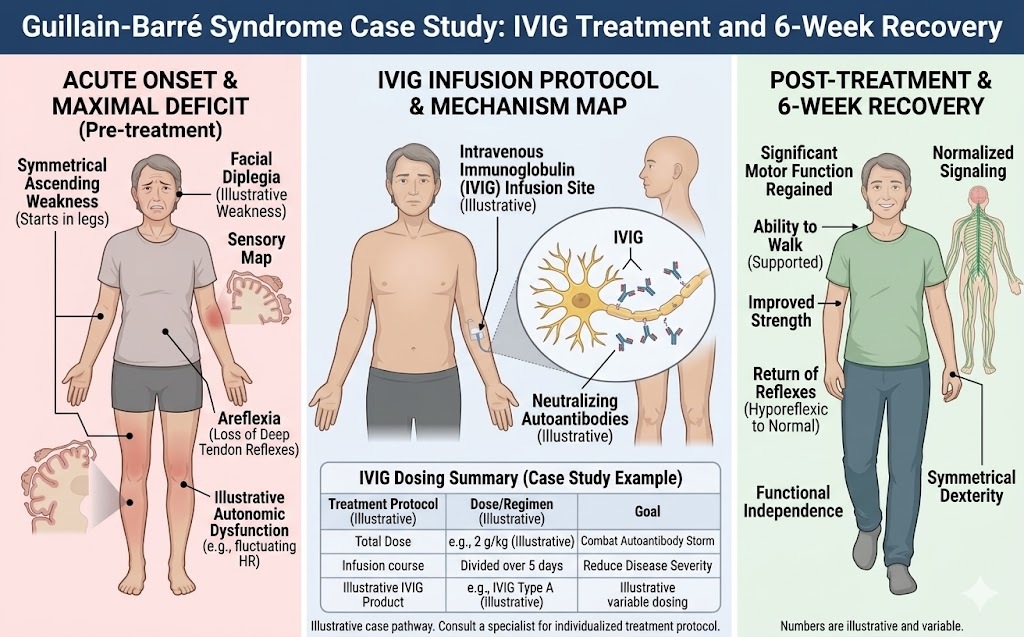
A 42-year-old businessman from Hyderabad presented with tingling in the feet that climbed to the thighs over four days, followed by progressive weakness of both legs and then the hands. He had recovered from a diarrhoeal illness three weeks earlier. A clinical and electrophysiological diagnosis of Guillain-Barré syndrome (acute inflammatory demyelinating polyradiculoneuropathy) was made and intravenous immunoglobulin (IVIG) therapy was initiated within 24 hours of admission. He plateaued on day 6, began climbing back on day 10, and was walking independently at the six-week mark.
PATIENT PROFILE
Field | Detail |
Age | 28 years |
Gender | Female |
Occupation | Software Engineer |
City | Bengaluru, India |
Illness Duration | 2 weeks prior to admission; 6 months of structured treatment and recovery |
Presenting Complaint | Behavioural change, paranoid delusions, new-onset focal-to-bilateral tonic-clonic seizures, episodes of catatonia and mutism |
Diagnosis | Definite anti-NMDA receptor autoimmune encephalitis (CSF and serum anti-NMDAR antibodies positive) |
Treatment Period | 2025–2026 |
Outcome | Excellent. Modified Rankin Scale 0 at 6 months; return to full pre-illness function; no seizure recurrence |
THE PROBLEM
It started with his feet. Three weeks after a brief episode of food poisoning that he had largely forgotten about, he woke up one morning with the kind of pins-and-needles in his soles that he assumed was from sleeping awkwardly. Over the next two days the tingling crept up to his calves, then to his thighs. On the fourth day his knees buckled twice as he stood up from his office chair. On the fifth day he could not climb the single flight of stairs to his apartment without holding the railing with both hands. His grip began slipping. He dropped a coffee mug, then a phone.
By the time he was wheeled into the emergency department, he could not stand without support, his ankle and knee reflexes were absent, and he was beginning to notice that his fingers felt clumsy when he tried to button his shirt. He was anxious but lucid. His voice was normal. He had no difficulty swallowing yet, but he had read enough online to know that GBS could spread upward to the breathing muscles, and that was the question he asked first: am I going to stop being able to breathe.
CONSULTATION & TREATMENT PLAN
What Was Assessed During the GBS Workup
- Detailed history of antecedent infection (diarrhoeal or respiratory), vaccination, and the time course of weakness and sensory symptoms
- Full neurological examination documenting symmetrical weakness, distal-to-proximal pattern, areflexia, and sensory level
- Hughes Functional Grade and MRC sum score recorded as objective baselines for tracking progression and recovery
- Single-breath count and bedside spirometry (forced vital capacity) to track respiratory muscle strength every 4 hours
- Lumbar puncture for CSF analysis, looking for albumino-cytological dissociation (raised protein with normal cell count) typical of GBS
- Nerve conduction studies and electromyography to confirm demyelinating features and exclude axonal variants — and to distinguish GBS from other demyelinating conditions such as multiple sclerosis, which affects the central rather than peripheral nervous system
- MRI lumbosacral spine with contrast in the workup to exclude alternative pathology and to look for nerve root enhancement supportive of GBS
- Stool studies and serology for Campylobacter jejuni given the antecedent gastroenteritis
- Cardiac and autonomic monitoring with continuous ECG, blood pressure tracking, and urinary output charting
Why Intravenous Immunoglobulin (IVIG) Was Chosen
- IVIG and plasma exchange are equally effective first-line treatments for GBS; IVIG was chosen for ease of administration and the patient’s peripheral venous access being adequate
- Treatment was started within 24 hours of admission, well within the 2-week window during which immunotherapy is known to alter outcome
- He had a clear progressive deficit (Hughes Grade 4, unable to walk unaided), which is an unambiguous indication for immunotherapy
- No contraindications to IVIG were identified on screening: renal function was normal, there was no IgA deficiency, and no history of thrombosis or hypercoagulable state
- Plasma exchange was kept in reserve as a rescue option in case of treatment-related fluctuation or poor response — the same combination of agents is also used in conditions like autoimmune encephalitis, where immune-mediated nervous system injury responds to similar therapy
- Early respiratory monitoring and ICU bed availability were arranged regardless of treatment choice, given that 20 to 30 percent of GBS patients require ventilation
Pre-Treatment Clinical Status
At admission, his Hughes Functional Grade was 4: bedridden or chair-bound, unable to walk even with assistance for short distances. The MRC sum score was 38 out of 60, reflecting significant proximal and distal weakness in all four limbs. Forced vital capacity was 28 ml/kg, still safe but trending downward. Reflexes were absent throughout. CSF protein was elevated at 90 mg/dl with only 2 cells/mm³, the classic albumino-cytological dissociation. Nerve conduction studies showed prolonged distal motor latencies, reduced conduction velocities, and prolonged F-wave latencies consistent with AIDP. Stool serology subsequently confirmed recent Campylobacter jejuni infection.
Diagnostic and Treatment Basis
- Admitted to a high-dependency unit with adjacent ICU access for close respiratory and autonomic monitoring
- IVIG started within 24 hours of admission at 0.4 g/kg/day for 5 consecutive days (total 2 g/kg cumulative dose)
- Pre-medication with paracetamol and antihistamine before each IVIG infusion; slow titration of infusion rate to minimise headache and flushing
- Hydration optimised before and during infusions to reduce the risk of thromboembolism and renal stress
- Forced vital capacity and single-breath count measured 4-hourly; clear escalation criteria for ICU transfer and intubation discussed with the family on day 1
- DVT prophylaxis with low-molecular-weight heparin and graduated compression stockings, given immobility
- Neuropathic pain managed with gabapentin titrated to effect; opioids avoided where possible because of constipation and autonomic risk
- Early physiotherapy with passive range-of-motion exercises started on day 2, progressing to active assisted exercises as power returned
- Swallowing assessment performed daily; soft diet maintained until bulbar safety was confirmed
- Psychological support and clear daily communication with the patient and family about the expected stepwise course of recovery
Treatment Facts
Field | Detail |
Diagnosis | Guillain-Barré syndrome, AIDP variant, post-Campylobacter jejuni |
Primary Treatment | Intravenous immunoglobulin (IVIG) 0.4 g/kg/day for 5 days (total 2 g/kg) |
Supportive Treatment | Respiratory monitoring, DVT prophylaxis, neuropathic pain control, early physiotherapy |
Antecedent Trigger | Recent Campylobacter jejuni gastroenteritis (serologically confirmed) |
Mechanical Ventilation | Not required |
Autonomic Events | Mild orthostatic hypotension only; no arrhythmia |
HDU/ICU Stay | 8 days in high-dependency unit |
Total Hospital Stay | 18 days |
Immediate Complications | Mild headache and transient rise in serum creatinine during IVIG; both self-limiting |
Outcome Measurement
GBS recovery follows a characteristic curve: progression, plateau, then gradual improvement. He stopped getting worse on day 6, plateaued for about 4 days, and began to climb back from day 10. Recovery was tracked using the Hughes Functional Grade, MRC sum score, and timed walking measures, compared between admission, discharge, and the 6-week follow-up. For a patient-friendly walkthrough of what each of these phases feels like, see our detailed guide on the Guillain-Barré Syndrome recovery timeline.
| Assessment Domain | Admission | Discharge | 6 Weeks |
|---|---|---|---|
| Clinical Outcomes | |||
| Hughes Functional Grade | 4 (chair-bound) | 3 (walks with help) | 1 (minor symptoms) |
| MRC Sum Score | 38 / 60 | 48 / 60 | 58 / 60 |
| Forced Vital Capacity | 28 ml/kg | 42 ml/kg | Normal for age |
| 10-metre Walk Test | Unable | With walker | Independent, normal pace |
| Hand Grip (dominant) | Severely reduced | Moderately reduced | Near-normal |
| Neuropathic Pain (NRS) | 7 / 10 | 3 / 10 | 1 / 10 |
OUTCOMES AT A GLANCE
Domain | Result |
Limb Power | Near-complete recovery in all four limbs; mild residual distal weakness only |
Walking | Independent walking restored; no assistive device required at 6 weeks |
Respiratory Function | Never required ventilation; FVC fully recovered |
Autonomic Function | Stable throughout; mild transient orthostatic dips resolved |
Sensory Symptoms | Tingling and neuropathic pain substantially reduced; gabapentin being tapered |
Reflexes | Returning at knees and elbows; ankle reflexes still absent at 6 weeks, expected to recover over months |
Functional Status | Returned to running his business; resumed driving at week 5 |
Complications | Mild IVIG-related headache and transient creatinine rise during treatment; both resolved |
PATIENT FEEDBACK
Google Review ★★★★★ 5.0 — Verified Patient (Name withheld for privacy)
“In one week I went from running my business to not being able to stand up from my chair. The most frightening part was wondering whether the weakness would reach my breathing. The team explained the entire course of GBS to me on the first day. They told me it would get worse before it got better, and exactly when to expect the turnaround. The IVIG was started the same evening. When I took my first independent step on the ward with the physiotherapist, it felt unreal. Six weeks later I am back at the office, driving myself, and only my ankle reflexes remind me of what happened.”
Profile: Male │ 42 years │ Businessman │ Hyderabad Procedure: IVIG therapy for post-viral Guillain-Barré syndrome Neurologist: Dr. Guruprasad Hosurkar & Neuromuscular Team
POST-PROCEDURE CARE & LONG-TERM MANAGEMENT
- Continue structured physiotherapy at home with a defined progression from balance and gait re-training to strengthening and endurance work
- Walk on level ground initially; introduce stairs, uneven surfaces, and longer distances gradually under physiotherapist guidance
- Continue gabapentin for neuropathic pain at the prescribed dose; tapering will be planned once symptoms remain stable for several weeks
- Watch for treatment-related fluctuation in the first 2 months: any new or worsening weakness, even mild, should be reported immediately
- Maintain good hydration and avoid prolonged immobility for long-distance travel for the first 3 months
- Delay non-essential vaccinations, particularly live vaccines, until cleared by the treating neurologist; influenza vaccination can be reconsidered after individualised assessment
- Avoid heavy alcohol use and over-the-counter sedatives, which can mask early signs of fatigue or recurrent weakness
- Resume work in a graded fashion; office-based duties first, with longer hours and travel reintroduced over several weeks
- Attend scheduled outpatient neurology and physiotherapy reviews under a movement-focused neurologist; repeat nerve conduction studies are scheduled at 3 and 6 months if clinically indicated
- Return urgently for any new weakness, breathing difficulty, swallowing problems, severe constipation, palpitations, or sudden drop in blood pressure
Recovery Timeline
| Phase | Detail |
| Day 1 | Admission. Diagnosis confirmed clinically and electrophysiologically. IVIG started within 24 hours. Respiratory monitoring in place. |
| Day 2 to 5 | Daily IVIG infusions completed. Weakness still progressing in the first 48 hours, then beginning to stabilise. Early physiotherapy initiated. |
| Day 6 to 10 | Clinical plateau. No further deterioration. Respiratory function stable. Active assisted exercises and sitting tolerance built up. |
| Day 10 to 14 | First clear signs of improvement: hip flexors, then shoulder abductors. Stands with assistance. Transfers improve. |
| Day 15 to 18 | Walks short distances with a walker. Discharged home with structured physiotherapy plan and follow-up schedule. |
| Week 3 to 4 | Walker replaced by no aid for indoor walking. Outdoor walking with caution. Hand function recovering. Neuropathic pain easing. |
| Week 6 | Formal re-assessment. Hughes Grade 1. Independent walking, driving resumed. Gabapentin taper considered. |
| Long-term | Ongoing physiotherapy, monitoring for residual deficits, awareness of relapse-mimicking treatment-related fluctuation, and gradual return to full pre-illness activity. |
Guillain-Barré syndrome is a medical emergency where the window for IVIG to alter the disease course is narrow. If you or a loved one is experiencing rapidly ascending weakness, tingling that’s climbing the limbs, or sudden difficulty with grip or stairs after a recent infection, contact Dr. Guruprasad Hosurkar without delay earlier treatment means faster, more complete recovery.
DISCLAIMER: This case study is for informational purposes only and does not constitute medical advice. Individual results may vary. Consult a qualified neurologist before undergoing any treatment. Patient feedback published with written consent. Patient identity withheld per confidentiality guidelines.