
Bilateral STN Deep Brain Stimulation in a 62-Year-Old with Advanced Parkinson’s Disease: From Medication-Resistant Tremor to Functional Independence
A 62-year-old retired bank manager from Bangalore came to KIMS Hospital after eight years of living with Parkinson’s disease that had outgrown his medications. His tremor was severe, his “off” periods were stretching longer each month, and afternoon dyskinesias were making daily life unpredictable. Dr. Guruprasad Hosurkar, Head of the Movement Disorders and Parkinson’s Disease Programme at KIMS, confirmed him as a strong candidate for deep brain stimulation and performed bilateral subthalamic nucleus (STN) DBS. At the first stimulator programming visit, the tremor stopped. At six months, his motor score had improved by 65 percent and his daily levodopa dose had been cut by nearly two-thirds.
PATIENT PROFILE
| AGE | 62 years |
| GENDER | Male |
| OCCUPATION | Retired Bank Manager |
| CITY | Bangalore, India |
| DISEASE DURATION | 8 years |
| PRESENTING COMPLAINT | Severe tremor and rigidity, wearing-off phenomenon, and dyskinesias despite optimised medication |
| DIAGNOSIS | Advanced idiopathic Parkinson’s disease with motor fluctuations (tremor-dominant subtype) |
| DATE OF PROCEDURE | 2025 |
| OUTCOME | Excellent. 65% improvement in MDS-UPDRS motor score, 64% reduction in levodopa dose |
THE PROBLEM
Parkinson’s disease had been in his life for eight years. The early years were manageable. A small tremor in the right hand. A slower walk. Tablets three times a day, and life went on. Then about two years ago, the tremor started winning. It spread to both hands, and then to the jaw. Each tablet worked for less time than before. He started counting the minutes between doses.
By the time he walked into the clinic, he had stopped attending family functions. He could not sign papers. He could not hold a cup of tea without spilling it. Every afternoon the medication would push him into involuntary dance-like movements, and an hour later he would freeze up again. He and his wife had read about DBS online, spoken to one other doctor, and come to KIMS specifically because Dr. Guruprasad heads the Movement Disorders and Parkinson’s Disease Programme there. What they wanted was straightforward: get the tremor under control, and get some of their old life back.
CONSULTATION & TREATMENT PLAN
What Was Assessed During the DBS Workup
- Full MDS-UPDRS scoring in both “off” and “on” medication states, documenting motor severity and levodopa responsiveness
- Levodopa challenge test to confirm greater than 30 percent motor improvement with medication, a key predictor of DBS response
- Diagnosis reconfirmed as idiopathic Parkinson’s disease, with atypical Parkinsonian syndromes (PSP, MSA, CBD) and conditions like essential tremor ruled out on history, examination, and MRI
- Detailed neuropsychological assessment to rule out significant cognitive impairment or dementia
- Psychiatric screening for active depression, psychosis, or suicidal ideation, which can be worsened by STN stimulation
- Brain MRI reviewed for structural abnormalities and to plan the stereotactic trajectory
- Medical fitness evaluation for general anaesthesia and for tolerating a multi-hour surgery
- Detailed counselling of the patient and family about realistic expectations, risks, and the lifelong nature of device follow-up
Why Bilateral STN DBS Was Chosen
- The patient showed more than 30 percent improvement with levodopa, the single strongest predictor of a good DBS outcome
- His symptoms were bilateral, severe, and symmetrical enough to justify bilateral electrodes rather than a unilateral approach
- Tremor and motor fluctuations were the dominant problem, both of which respond well to subthalamic nucleus stimulation
- STN targeting allows a meaningful reduction in levodopa dose after surgery, which also reduces dyskinesias
- He had no active mood disorder, cognitive decline, or medical contraindication that would push the decision toward a GPi target instead
- Age and general health profile placed him well within the accepted candidacy window
PRE-OPERATIVE MOTOR ASSESSMENT
The baseline MDS-UPDRS scoring in the “off” medication state set the benchmark against which the DBS outcome would be measured. His motor score of 52 out of 132 placed him in the severe range, with tremor and bradykinesia as the biggest contributors. His daily levodopa equivalent dose had climbed to 1250 mg, and he was still spending around six hours a day in the “off” state. These numbers gave both the team and the family a concrete target to aim for, and later, a concrete measure of success under the care of Dr. Guruprasad Hosurkar.
DIAGNOSTIC BASIS
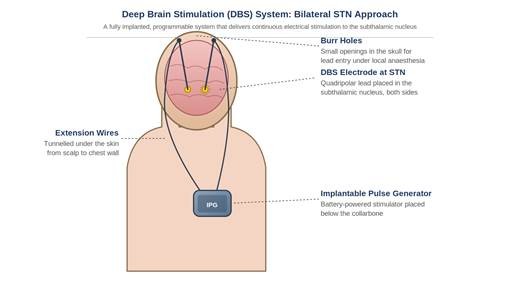
- Stereotactic frame fixed to the skull under local anaesthesia, followed by a high-resolution planning MRI
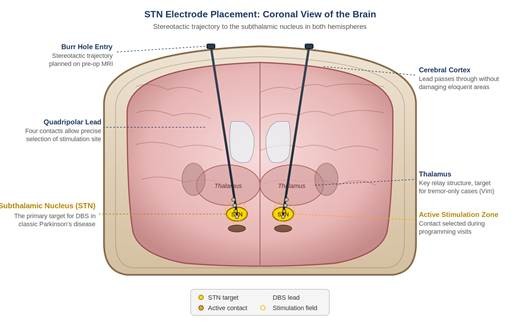
- Trajectory planned bilaterally to target the subthalamic nucleus, avoiding blood vessels, ventricles, and eloquent cortex
- Two small burr holes made in the skull under local anaesthesia
- Microelectrode recording used intraoperatively to confirm correct placement in the STN, identified by characteristic neuronal firing patterns
- Test stimulation performed with the patient awake to check for tremor suppression and to screen for stimulation-related side effects
- Permanent quadripolar DBS leads placed at the optimal coordinates once recordings and test stimulation confirmed the target
- Patient shifted under general anaesthesia for the second stage, in which the extension wires were tunnelled from the scalp down to the chest
- Implantable pulse generator (IPG) placed in a subcutaneous pocket below the right clavicle and connected to the lead extensions
- Wounds closed in layers and patient recovered in the neurosurgical ICU overnight for observation
TREATMENT FACTS
PROCEDURE | Bilateral STN Deep Brain Stimulation (staged, single-sitting) |
TARGET | Subthalamic nucleus (STN), both sides |
DURATION | Approximately 6 to 7 hours including stereotactic planning |
ANAESTHESIA | Local for electrode placement (patient awake), general for IPG implantation |
GUIDANCE | Stereotactic MRI planning + intraoperative microelectrode recording |
DEVICE | Quadripolar DBS leads + chest-wall implantable pulse generator (IPG) |
INTRAOPERATIVE COMPLICATIONS | None |
HOSPITAL STAY | 4 days, including 1 night of post-operative ICU observation |
STIMULATOR PROGRAMMING & OUTCOME MEASUREMENT
The stimulator was switched on at a follow-up visit about three weeks after surgery, once the initial post-operative swelling had settled. Programming is a patient-specific process. Each of the four contacts on each lead is tested in turn for best tremor suppression and fewest side effects, and amplitude, pulse width, and frequency are titrated over several visits. At the six-month mark, his MDS-UPDRS scores were repeated and compared against the pre-operative baseline.
MDS-UPDRS OUTCOMES: PRE-DBS VS POST-DBS (6 MONTHS)
ASSESSMENT DOMAIN | PRE-DBS (OFF MEDS) | POST-DBS (ON STIM) | IMPROVEMENT |
MDS-UPDRS Part III (Motor Examination) | 52 / 132 | 18 / 132 | 65% better |
Tremor sub-score | 14 / 20 | 2 / 20 | 86% better |
Rigidity sub-score | 12 / 20 | 4 / 20 | 67% better |
Bradykinesia sub-score | 16 / 32 | 6 / 32 | 63% better |
MDS-UPDRS Part II (Daily Living) | 28 / 52 | 10 / 52 | 64% better |
Levodopa Equivalent Daily Dose | 1250 mg/day | 450 mg/day | 64% reduction |
“Off” time per day | ~6 hours | ~1 hour | Near elimination |
OUTCOMES AT A GLANCE
Tremor | Near-complete suppression in both hands |
Rigidity | Substantially reduced, more fluid movement |
Bradykinesia | Walking speed, handwriting, and finger dexterity all improved |
Motor Fluctuations | “Off” time reduced from about 6 hours a day to under 1 hour |
Dyskinesias | Resolved in parallel with the reduction in levodopa dose |
Quality of Life | Returned to daily walks, family functions, and personal care without assistance |
Complications | None reported at the 6-month follow-up |
These outcomes reflect the structured DBS programme delivered by an experienced neurologist in Bangalore, where every case is assessed, planned, and programmed in stages rather than rushed.
PATIENT FEEDBACK
Google Review ★ ★ ★ ★ ★ 5.0 Verified Patient (Name withheld for privacy) “For almost eight years I was a prisoner of the tremor. I had stopped going to family functions because I could not even hold a glass of water. The tablets were not working like before and I had bad dyskinesias every afternoon. Dr. Guruprasad explained the DBS surgery to us very patiently, again and again, until my wife and I understood everything. The day they switched on the stimulator I cried. My hand was still. I could drink tea on my own. I am back to my morning walks now and my grandson says I look younger.” Profile: Male | 62 years | Retired Bank Manager | Bangalore Procedure: Bilateral STN DBS for Advanced Parkinson’s Disease | KIMS Hospital, Bangalore | 2025 Neurologist: Dr. Guruprasad Hosurkar | KIMS Hospital, Mahadevapura Note: Due to privacy regulations, we cannot display the patient’s name. This review has been shared with written consent. |
POST-DISCHARGE CARE & LONG-TERM MANAGEMENT
- Use the home CPAP machine every night, for the whole sleep duration, without skipping
- Keep a simple log of nightly CPAP use and report any mask discomfort at the follow-up visit
- Continue all prescribed antihypertensive medications and do not self-adjust doses
- Monitor blood pressure at home twice daily and maintain a written record
- Attend physiotherapy and speech therapy sessions as scheduled for post-stroke recovery
- Follow the dietician’s plan for weight reduction ahead of bariatric surgery
- Avoid alcohol and sedatives, which worsen obstructive sleep apnea
- Return immediately if drowsiness, new weakness, slurred speech, or severe headache develops
- Keep all scheduled follow-up visits with the neurology and sleep medicine team
POST-PROCEDURE CARE & LONG-TERM MANAGEMENT
- Keep the scalp and chest wounds clean and dry; avoid pulling or scratching around the incision sites
- Avoid contact sports, heavy lifting, and head impact for at least 6 to 8 weeks after surgery
- Do not stop Parkinson’s medications on your own; all dose changes must be done by the neurologist in step with programming
- Attend all scheduled programming and follow-up visits in the first 6 months, as the stimulator settings are fine-tuned in stages
- Carry the patient identification card for the DBS device at all times, especially in airports and hospitals
- Inform every treating doctor and dentist that you have an active neurostimulator before any procedure
- Avoid MRI scans unless specifically cleared for your device model, and avoid diathermy and strong magnetic fields
- Monitor the IPG battery status at each follow-up; non-rechargeable generators will need replacement after several years
- Continue physiotherapy and speech therapy as advised, as they significantly enhance the motor gains from DBS
- Return immediately if you notice new weakness, seizures, confusion, wound discharge, fever, or a sudden return of severe tremor
RECOVERY TIMELINE
Day 1 | Surgery. Overnight observation in the neurosurgical ICU. |
Day 2 to 4 | Shifted to ward. Mobilisation, wound checks, post-op MRI to confirm lead position. Discharged on day 4. |
Week 1 to 2 | Wound healing. Stimulator OFF. Patient continues pre-operative medication doses. |
Week 3 to 4 | First programming visit. Stimulator switched ON. Initial settings established. |
Month 2 to 3 | Second and third programming visits. Fine-tuning of amplitude, pulse width, and frequency. Gradual levodopa dose reduction. |
Month 6 | Formal re-assessment with MDS-UPDRS. Stable settings reached. Rehabilitation and lifestyle reintegration in full swing. |
Long-term | Annual programming review. IPG battery monitoring. Ongoing neurology follow-up for disease progression and medication balance. |
DISCLAIMER: This case study is for informational purposes only and does not constitute medical advice. Individual results may vary. Consult a qualified neurologist before undergoing any treatment. Patient feedback published with written consent. Patient identity withheld per confidentiality guidelines.