
Botulinum Toxin Injections in a 45-Year-Old with Cervical Dystonia: From Painful Neck Spasms to Restored Mobility
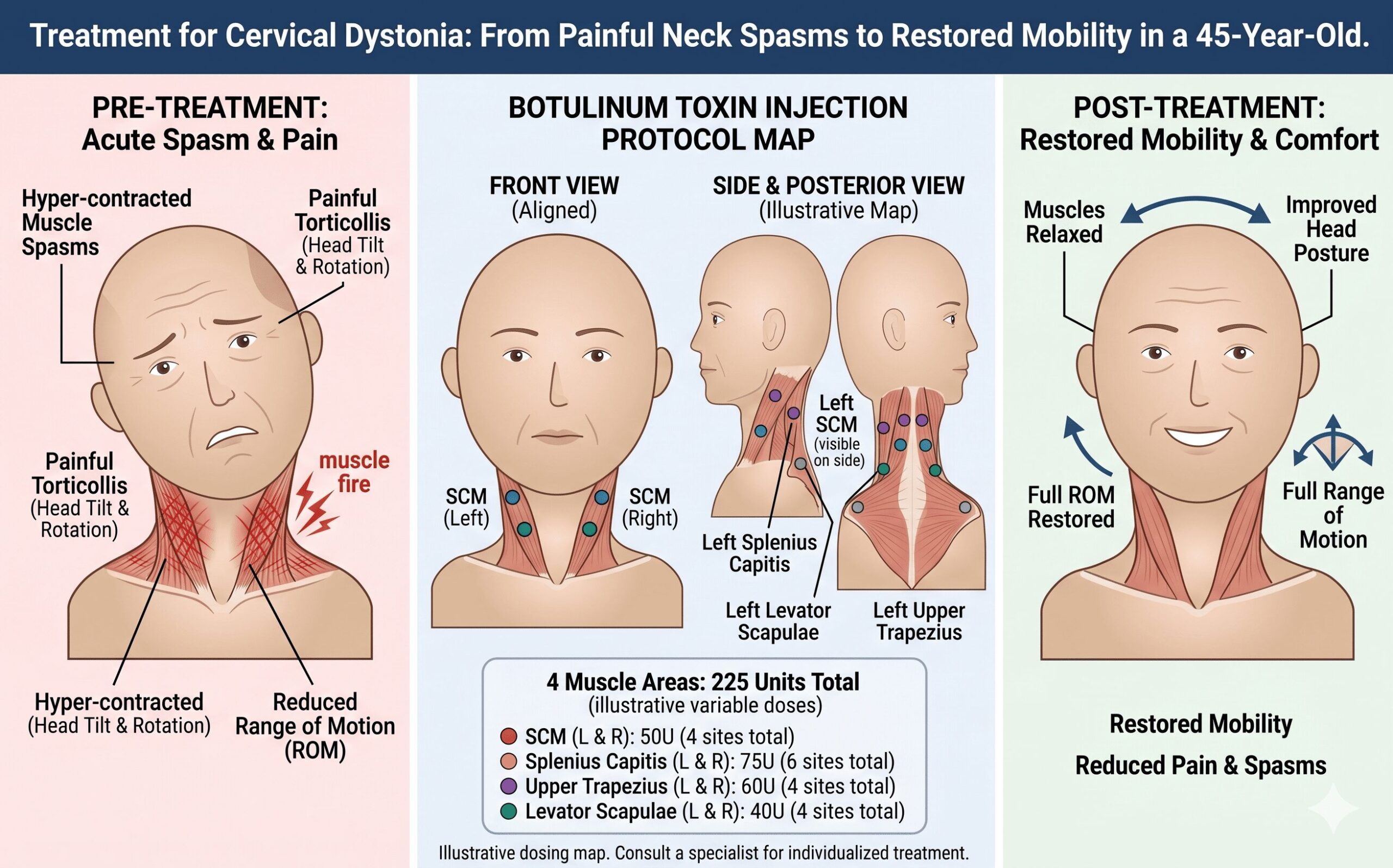
A 45-year-old school teacher from Pune presented with two years of progressive, painful involuntary neck twisting that had begun to interfere with teaching, driving, and sleep. She had tried oral muscle relaxants and physiotherapy without lasting relief. After a structured movement disorders assessment confirmed idiopathic cervical dystonia of the torticollis subtype, she underwent EMG-guided botulinum toxin type A injections into the dystonic neck muscles. Within ten days, the abnormal posture had eased visibly, the pain had dropped sharply, and by the six-week review she had returned to full-time work without restriction.
PATIENT PROFILE
Field | Detail |
Age | 45 years |
Gender | Female |
Occupation | School Teacher |
City | Pune, India |
Disease Duration | 2 years |
Presenting Complaint | Painful involuntary leftward neck twisting, head tremor, and difficulty maintaining a midline head position |
Diagnosis | Idiopathic cervical dystonia (torticollis subtype) with associated dystonic head tremor |
Date of Procedure | 2025 |
Outcome | Excellent. ~70% reduction in TWSTRS severity score, near-complete pain relief, return to full occupational function |
THE PROBLEM
It started quietly. A pulling sensation in the left side of her neck at the end of long teaching days, which she put down to standing at the blackboard. Over the next few months the pull became a turn. Her head began drifting to the left on its own, especially when she was tired or stressed, and she found herself using her right hand to physically push it back to centre. By the time she came to the clinic, the abnormal posture was nearly constant during the day. The pain had spread from her neck into her left shoulder and up into the back of her head. A fine tremor had crept in on top of the twisting, so even when she managed to hold her head straight, it would not stay still.
She had stopped driving long distances. She could no longer turn her head smoothly to check her blind spot, and the spasms would worsen the moment she tried. Marking notebooks at her desk had become painful. Sleep was broken because she could not find a comfortable position for her head on the pillow. She had been to two doctors before, tried trihexyphenidyl and clonazepam at low doses, done a course of physiotherapy, and felt that none of it had touched the core problem. She came in asking a direct question: was there a treatment that would actually stop the spasms, not just blunt them.
CONSULTATION & TREATMENT PLAN
What Was Assessed During the Movement Disorders Workup
- Detailed history of onset, progression, sensory tricks (geste antagoniste), aggravating and relieving factors, and family history of dystonia
- Full neurological examination with focused inspection of head and neck posture in sitting, standing, and walking
- Toronto Western Spasmodic Torticollis Rating Scale (TWSTRS) scoring across severity, disability, and pain domains to set an objective baseline
- Identification of the dominant dystonic muscles by palpation and observation of the pattern of pull, rotation, tilt, and shift
- Surface and needle EMG assessment of the sternocleidomastoid, splenius capitis, levator scapulae, and trapezius muscles bilaterally
- MRI brain and cervical spine reviewed to exclude structural lesions, demyelination, or cervical cord pathology mimicking dystonia
- Screening for secondary causes including drug-induced dystonia, Wilson’s disease in younger patients, and post-traumatic dystonia
- Counselling about the nature of botulinum toxin therapy, the time course of benefit, the need for repeat injections every 3 to 4 months, and realistic expectations
Why EMG-Guided Botulinum Toxin Type A Was Chosen
- Botulinum toxin type A is the first-line, guideline-recommended treatment for cervical dystonia worldwide, with high-quality evidence for both severity and pain reduction
- Her pattern of contralateral sternocleidomastoid and ipsilateral splenius capitis overactivity was well suited to focal chemodenervation
- Oral agents had already failed at tolerated doses and were causing drowsiness that affected her classroom work
- EMG guidance was preferred over landmark-only injection because of the involvement of deeper muscles, particularly splenius capitis and levator scapulae
- She did not have generalised dystonia or severe disability that would push the conversation toward deep brain stimulation at this stage
- Pain was a prominent feature, and botulinum toxin reliably addresses dystonia-related pain as well as the abnormal posture
Pre-Treatment Assessment
Baseline TWSTRS scoring placed her in the moderate-to-severe range. Severity sub-score was 19 out of 35, disability sub-score 14 out of 30, and pain sub-score 16 out of 20. Pain was, in her own words, the part she most wanted gone. The EMG mapping confirmed sustained overactivity in the right sternocleidomastoid and left splenius capitis, with secondary activation of the left levator scapulae and bilateral upper trapezius. These were the targets selected for injection, with doses calibrated to muscle size and degree of overactivity.
Diagnostic and Procedural Basis
- Patient positioned semi-reclined with the head supported but unrestrained, allowing the dystonic posture to be observed
- Skin overlying the planned injection sites cleaned with antiseptic; no sedation required
- Hollow Teflon-coated EMG needle electrode introduced into each target muscle under real-time EMG monitoring
- Position within the dystonic muscle confirmed by the characteristic motor unit discharge pattern at rest and on activation
- Botulinum toxin type A delivered at calculated doses per muscle: right sternocleidomastoid 50 units, left splenius capitis 70 units, left levator scapulae 40 units, bilateral upper trapezius 30 units each
- Total dose kept within the recommended ceiling for a single session, with dose distribution biased toward the most overactive muscles on EMG
- Each injection site observed briefly for local bleeding; light pressure applied
- Patient observed in the clinic for 20 minutes post-procedure and discharged the same day with written aftercare instructions
Treatment Facts
| Procedure | EMG-guided botulinum toxin type A injections |
|---|---|
| Target Muscles | Right sternocleidomastoid, left splenius capitis, left levator scapulae, bilateral upper trapezius |
| Total Dose | 250 units of botulinum toxin type A |
| Duration | Approximately 30 minutes |
| Anaesthesia | Not required (topical anaesthetic cream optional) |
| Guidance | Electromyographic (EMG) guidance |
| Device | Hollow Teflon-coated EMG needle electrode with EMG recording unit |
| Immediate Complications | None |
| Day-Care Stay | Out-patient day-care procedure; discharged the same day |
Outcome Measurement
Onset of benefit followed the expected pharmacological time course. Mild softening of the neck pull began at around day 5. By day 10, the abnormal posture had visibly improved, and pain had dropped to a level she described as a background ache rather than a constant pull. Peak benefit was reached at approximately 4 to 6 weeks. TWSTRS was repeated at the six-week follow-up against the pre-treatment baseline.
| Assessment Domain | Pre-Injection | Post-Injection | Improvement |
|---|---|---|---|
| TWSTRS Core Assessments | |||
| TWSTRS Severity | 19 / 35 | 6 / 35 | 68% better |
| TWSTRS Disability | 14 / 30 | 4 / 30 | 71% better |
| TWSTRS Pain | 16 / 20 | 3 / 20 | 81% better |
| TWSTRS Total | 49 / 85 | 13 / 85 | 73% better |
| Secondary Outcomes | |||
| Hours/day in abnormal posture | ~10 hours | ~1.5 hours | 85% reduction |
| Oral medication burden | Trihexyphenidyl + Clonazepam | Both tapered off | Discontinued |
OUTCOMES AT A GLANCE
| Headache Days / Month | Reduced from 22 to 7 (68% drop) |
| Severe Migraine Days | Reduced from 17 to 4 (76% drop) |
| Triptan Rescue Use | Reduced from 19 to 4 doses per month (79% drop) |
| MIDAS Disability Score | Reduced from 65 (Grade IV) to 10 (Grade II) |
| Workdays Missed (3 months) | Reduced from 13 to 1 |
| Medication-Overuse Risk | Resolved. Triptan use well below 10 doses/month threshold |
| Side Effects | None reported across 3 cycles |
PATIENT FEEDBACK
Google Review ★★★★★ 5.0 — Verified Patient (Name withheld for privacy)
“For two years I lived with a head that did not listen to me. The worst part was the pain, not the twisting. I had almost stopped driving and was thinking of taking long leave from school. The doctor explained the injection carefully, showed me the EMG, and told me exactly when I would feel the change. By the second week I could turn my head smoothly for the first time in months. By a month, I was back in the classroom standing tall again. I will need repeat injections, and I am completely okay with that, because the relief is real.”
Profile: Female │ 45 years │ School Teacher │ Pune Procedure: EMG-guided botulinum toxin type A for cervical dystonia Neurologist: Dr. Guruprasad Hosurkar, Movement Disorders Clinic
POST-PROCEDURE CARE & LONG-TERM MANAGEMENT
- Keep the head in a comfortable midline position; do not vigorously massage the injection sites for 24 hours
- Avoid lying flat for 4 hours after the injections to reduce the risk of toxin spread to unintended muscles
- Expect benefit to build gradually over 7 to 14 days and peak by 4 to 6 weeks
- Continue neck-focused physiotherapy and posture exercises as advised; the toxin and physiotherapy work best in combination
- Return earlier than scheduled if you develop new swallowing difficulty, breathing changes, or significant generalised weakness
- Mild local soreness, brief neck weakness, or a feeling that the head is “too loose” for a few days is expected and self-limiting
- Plan for repeat injections every 12 to 16 weeks; do not wait until the previous dose has fully worn off, as this prolongs disability
- Maintain a simple home diary noting pain score, posture, and number of good hours per day to guide future dose adjustments
- Inform any other treating doctor or dentist about ongoing botulinum toxin therapy before procedures or new prescriptions
- Continue routine review with the movement disorders clinic to monitor pattern, dose, and need for adjuvant therapies
Recovery Timeline
Phase | Detail |
Day 0 | Injection day. Procedure done in clinic. Discharged the same day with aftercare instructions. |
Day 1 to 4 | Mild local soreness at injection sites. No restriction on routine activities other than avoiding heavy lifting and vigorous neck massage. |
Day 5 to 10 | Early onset of benefit. Neck pull begins to soften. Pain starts to ease. |
Week 3 to 4 | Approaching peak effect. Posture visibly improved. Functional gains in driving, work, and sleep. |
Week 6 | Formal re-assessment with TWSTRS. Tapering of oral medications begun under supervision. |
Week 12 to 16 | Scheduled re-injection before symptoms fully return, with dose adjustment based on response pattern. |
Long-term | Quarterly cycle of injections, ongoing physiotherapy, periodic EMG mapping if pattern shifts, monitoring for antibody-mediated reduced response. |
If you or someone you know is living with painful involuntary neck twisting that hasn’t responded to oral medication or physiotherapy, an experienced movement disorders neurologist can map the dystonic muscles precisely and tailor a botulinum toxin plan around your pattern of pull. Book a consultation with Dr. Guruprasad Hosurkar to discuss whether EMG-guided injections are right for you.
DISCLAIMER: This case study is for informational purposes only and does not constitute medical advice. Individual results may vary. Consult a qualified neurologist before undergoing any treatment. Patient feedback published with written consent. Patient identity withheld per confidentiality guidelines.