
Botulinum Toxin Therapy for Chronic Migraine in a 38-Year-Old IT Professional: PREEMPT Protocol and Restored Quality of Life
A 38-year-old IT project manager from Bangalore had been losing almost two-thirds of every month to migraine for more than a year. She had tried three preventive medications, was using a triptan rescue almost every other day, and had started to avoid meetings and family plans because she could not predict when the next attack would hit. Dr. Guruprasad Hosurkar confirmed a diagnosis of chronic migraine, ruled out medication-overuse headache, and started her on the FDA-approved PREEMPT protocol: 155 units of botulinum toxin across 31 injection sites, repeated every 12 weeks. By the third cycle her headache days had dropped from 22 to 7 a month, her MIDAS score had moved from severe disability to mild, and her triptan use had fallen by nearly 80 percent.
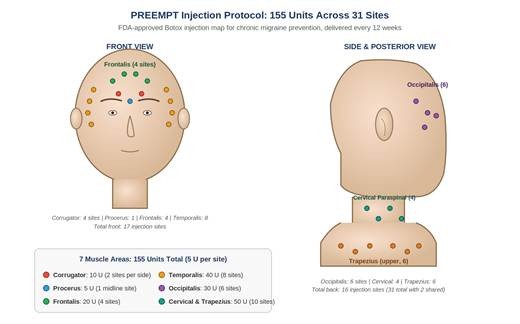
PATIENT PROFILE
AGE | 38 years |
GENDER | Female |
OCCUPATION | IT Project Manager |
CITY | Bangalore, India |
MIGRAINE HISTORY | 12+ years, worsening over the past 18 months |
PRESENTING COMPLAINT | 22 headache days per month, triptan rescue almost every other day, severe disability |
DIAGNOSIS | Chronic migraine without aura (ICHD-3), failed 3 oral preventives |
DATE TREATMENT STARTED | 2025 |
OUTCOME | Excellent. Headache days down 68%, MIDAS score reduced from 65 (Grade IV) to 10 (Grade II) |
THE PROBLEM
She had lived with migraine since her twenties, the way many people do. A few bad days a month, a tablet here and there, life moving on. About 18 months before she came to KIMS, the pattern shifted. The headaches stopped being occasional. They were landing on 20-plus days a month. Some were just a dull throb. Others were full-blown migraines with light sensitivity and vomiting that put her in bed for hours.
Three preventive medications later, she was still not better. A beta-blocker had dropped her blood pressure too much. An anticonvulsant had fogged her thinking at work. A tricyclic had given her weight gain and little else. She was reaching for a triptan almost every other day, which her family doctor warned her was edging into medication-overuse territory. She had stopped booking dinners. She had skipped her child’s school event. She came to Dr. Guruprasad specifically because a colleague told her he ran the headache clinic with a proper diary-based approach and was known for using Botox when it was genuinely indicated, and not as a first resort. Choosing the right neurologist in Bangalore makes the difference between a generic prescription and a structured headache plan.
CONSULTATION & TREATMENT PLAN
What Was Assessed During the Headache Workup
- Detailed headache diary over 4 weeks documenting 22 headache days per month, 17 of which met migraine criteria
- Diagnosis of chronic migraine confirmed per ICHD-3 criteria: greater than 15 headache days per month for more than 3 months, with 8 or more migraine-type days
- MIDAS questionnaire scored at 65, placing her in Grade IV severe disability
- Review of failed preventives: propranolol (not tolerated due to hypotension), topiramate (cognitive side effects), amitriptyline (weight gain and limited response)
- Triptan use reviewed, 19 doses per month, borderline for medication-overuse headache, discussed openly with patient
- Brain MRI done to rule out secondary causes, reported normal
- Screening for depression and anxiety, both mild, factored into planning
- Counselling about Botox realistic expectations: full benefit typically seen after the second or third cycle, not the first.
Why Botulinum Toxin (PREEMPT Protocol) Was Chosen
- She met every FDA-approved criterion for chronic migraine Botox: diagnosis confirmed, failure of at least 2 oral preventives, disabling symptoms
- Her triptan overuse pattern needed to be broken, and Botox offered a way to reduce attack frequency without adding another daily medication
- She had a demanding cognitive job, and she could not afford the sedation or mental fog that additional oral preventives had already caused
- Botox carries no systemic drug interactions, does not sedate, and does not add to daily pill burden, which is key for a working professional
- The PREEMPT protocol is a fixed, evidence-based 31-site, 155-unit regimen, and produces consistent results in properly selected patients
- If the first cycle produced less response than hoped, the protocol allows expansion to 195 units across up to 39 sites using the “follow-the-pain” strategy
PRE-TREATMENT BASELINE
Before the first Botox cycle, four weeks of diary data set a concrete baseline. Twenty-two headache days per month. Seventeen of those were severe migraines. Nineteen triptan doses per month. Thirteen workdays missed in three months, with productivity cut in half on another 18 days. Her MIDAS score stood at 65, the highest end of Grade IV severe disability. These were the numbers the treatment would be measured against at six months and again at nine months under the care of Dr. Guruprasad Hosurkar.
PROCEDURE DETAILS
- Patient seated comfortably, head stabilised, injection sites marked by palpation of the corrugator, procerus, frontalis, temporalis, occipitalis, cervical paraspinal, and trapezius muscle groups
- Skin cleaned with antiseptic, no local anaesthetic needed for the brief 30-gauge needle injections
- OnabotulinumtoxinA reconstituted to standard dilution (2 mL normal saline per 100-unit vial)
- 5 units (0.1 mL) delivered at each of 31 sites: 2 corrugator sites per side, 1 procerus, 4 frontalis, 8 temporalis, 6 occipitalis, 4 cervical paraspinal, 6 trapezius
- Each injection given intramuscularly or subdermally depending on site, following the PREEMPT injection depths
- Total procedure time approximately 15 to 20 minutes, fully outpatient
- Patient observed for 15 minutes after the injections for any immediate reaction, then discharged home
- Repeat cycle scheduled at 12 weeks, with a headache diary to be maintained between cycles
PROCEDURE FACTS
| Treatment | Onabotulinumtoxin A injections (PREEMPT Protocol) |
|---|---|
| Indication | Chronic migraine (ICHD-3), failed oral preventives |
| Total Dose | 155 units across 31 fixed sites |
| Muscle Areas | Corrugator, procerus, frontalis, temporalis, occipitalis, cervical paraspinal, trapezius |
| Needle | 30-gauge, 0.5 inch |
| Dilution | 2 mL preservative-free 0.9% saline per 100-unit vial (5 U per 0.1 mL) |
| Cycle Frequency | Every 12 weeks |
| Procedure Time | 15 to 20 minutes, outpatient |
| Anaesthesia | None required |
| Complications | None reported across 3 cycles |
OUTCOME MEASUREMENT: MIDAS AT 9 MONTHS
The MIDAS questionnaire was repeated at the 9-month follow-up, after three Botox cycles. The five core questions measure the exact opposite of what a patient wants. Days lost to headache at work, at home, and in social life over the past three months. Lower is better. Her numbers had dropped across every single domain.
| MIDAS Question (Days in the last 3 months) | Pre-Botox | Post-Botox |
|---|---|---|
| Activity Limitation (5 Core Questions) | ||
| Days missed from work or school because of headache | 13 | 1 |
| Days at work or school with productivity reduced by half or more | 18 | 3 |
| Days missed from household work | 11 | 2 |
| Days with household productivity reduced by half or more | 9 | 2 |
| Days missed from family, social, or leisure activities | 14 | 2 |
| TOTAL MIDAS SCORE | 65 | 10 |
| Disability Grade Interpretation | ||
| Grade I: Little or no disability | 0 to 5 | |
| Grade II: Mild disability | 6 to 10 | ◀ Post-Botox |
| Grade III: Moderate disability | 11 to 20 | |
| Grade IV: Severe disability | 21+ | ◀ Pre-Botox |
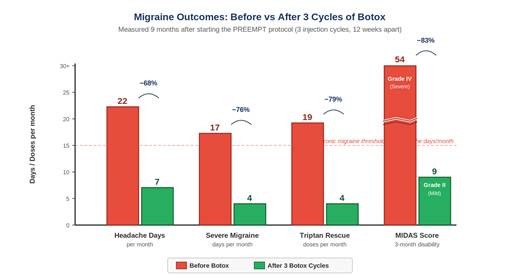
OUTCOMES AT A GLANCE
Headache Days / Month | Reduced from 22 to 7 (68% drop) |
Severe Migraine Days | Reduced from 17 to 4 (76% drop) |
Triptan Rescue Use | Reduced from 19 to 4 doses per month (79% drop) |
MIDAS Disability Score | Reduced from 65 (Grade IV) to 10 (Grade II) |
Workdays Missed (3 months) | Reduced from 13 to 1 |
Medication-Overuse Risk | Resolved. Triptan use well below 10 doses/month threshold |
Side Effects | None reported across 3 cycles |
Patients whose migraines overlap with dizziness or vestibular symptoms may also benefit from specialist vertigo treatment in Bangalore alongside botulinum toxin therapy.
PATIENT FEEDBACK
Google Review
★ ★ ★ ★ ★ 5.0
Verified Patient (Name withheld for privacy)
“I had reached the point where I was taking a triptan almost every other day and still losing half the month to headaches. My work was suffering and I had stopped making plans because I never knew when the next migraine would hit. Dr. Guruprasad walked me through the Botox option, told me it would take two to three cycles to really show results, and asked me to keep a headache diary. By the third cycle I was actually surprised how quiet my head had become. I still get a headache now and then, but nothing like before. I have my life back.”
Profile: Female | 38 years | IT Project Manager | Bangalore
Treatment: Botulinum Toxin (PREEMPT Protocol) for Chronic Migraine | KIMS Hospital, Bangalore | 2025
Neurologist: Dr. Guruprasad Hosurkar | KIMS Hospital, Mahadevapura
Note: Due to privacy regulations, we cannot display the patient’s name. This review has been shared with written consent.
POST-PROCEDURE CARE & LONG-TERM MANAGEMENT
- Avoid rubbing or massaging the injection sites for 24 hours after treatment
- Stay upright for 4 hours after injection to minimise toxin spread to unintended muscles
- Mild soreness, bruising, or a transient dull headache for 1 to 2 days after injection is expected; simple paracetamol is enough
- Maintain the headache diary every day, noting headache intensity, triggers, and any rescue medication used
- Continue acute rescue medication (triptan or NSAID) only when truly needed, and report the total monthly count at every follow-up visit
- Return for the next Botox cycle exactly at the 12-week mark, even if the current cycle is working well
- Do not expect the first cycle alone to give full benefit. Maximum response typically appears after the second or third cycle
- Continue lifestyle measures: regular sleep, hydration, meal timing, and stress management
- Inform any other treating doctor, including the dentist, that you have had botulinum toxin injections before any procedure in the head or neck region
- Return immediately if you develop new neurological symptoms, marked drooping of the eyelids, swallowing or breathing difficulty, or vision changes
TREATMENT TIMELINE
Week 0 | First Botox cycle. 155 units across 31 sites. Headache diary started. |
Week 1 to 2 | Initial subtle softening of attacks. Counselled that this is expected; full response takes longer. |
Week 4 to 8 | Noticeable reduction in attack intensity. Triptan use begins to fall. |
Week 12 | Second Botox cycle. Diary reviewed. Headache days down to about 12 per month. |
Month 4 to 5 | Patient reports clearer days, fewer missed workdays. MIDAS reassessed informally. |
Week 24 | Third Botox cycle. Headache days down to 8. Triptan use normalised. |
Month 9 | Formal MIDAS rescoring: 10 (Grade II). Outcome measurement complete. |
Long-term | Continue Botox every 12 weeks. Annual review of overall plan, stepping down if sustained low-frequency state is reached. |
DISCLAIMER: This case study is for informational purposes only and does not constitute medical advice. Individual results may vary. Consult a qualified neurologist before undergoing any treatment. Patient feedback published with written consent. Patient identity withheld per confidentiality guidelines.