
Anti-NMDA Receptor Autoimmune Encephalitis in a 28-Year-Old Female: From Seizures and Psychosis to Complete Neurological Recovery
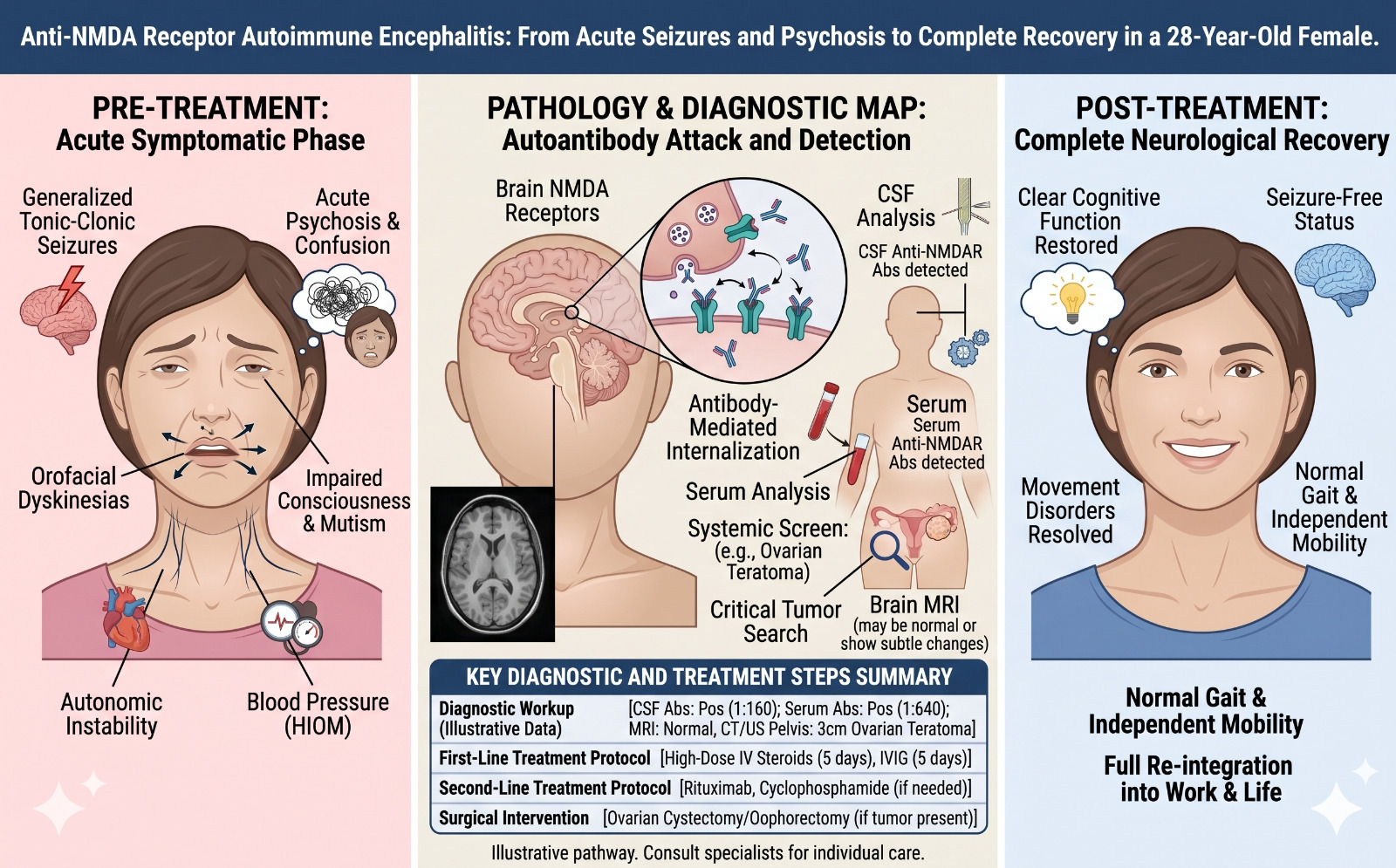
A 28-year-old software engineer was brought to the emergency department with a two-week history of behavioural change, paranoid delusions, and new-onset seizures, followed by an episode of catatonia. She had no prior psychiatric history. After a structured neurological and autoimmune workup confirmed anti-NMDA receptor antibody encephalitis, she was treated with first-line immunotherapy, escalated to rituximab when response stalled, and supported through orofacial dyskinesias and autonomic instability in the intensive care unit. At six months, she had returned to work full-time with normal cognition and no seizures.
PATIENT PROFILE
|
Field |
Detail |
|
Age |
28 years |
|
Gender |
Female |
|
Occupation |
Software Engineer |
|
City |
Bengaluru, India |
|
Illness Duration |
2 weeks prior to admission; 6 months of structured treatment and recovery |
|
Presenting Complaint |
Behavioural change, paranoid delusions, new-onset focal-to-bilateral tonic-clonic seizures, episodes of catatonia and mutism |
|
Diagnosis |
Definite anti-NMDA receptor autoimmune encephalitis (CSF and serum anti-NMDAR antibodies positive) |
|
Treatment Period |
2025–2026 |
|
Outcome |
Excellent. Modified Rankin Scale 0 at 6 months; return to full pre-illness function; no seizure recurrence |
THE PROBLEM
Her family said the change began with sleep. She started staying up at night, scrolling through her phone, then sleeping through morning meetings. Within a week she was anxious, then irritable, then convinced that her colleagues were tracking her laptop. She began speaking in fragments, repeating the same phrases, and laughing at things no one else found funny. Her parents took her to a psychiatrist, who started her on an antipsychotic and a sedative. Three days later she had her first seizure, witnessed in the bathroom, lasting nearly two minutes.
By the time she reached the emergency department, she was barely speaking, lying still with her eyes open, and making slow chewing movements with her jaw that did not stop even in sleep. Her heart rate would swing from 50 to 140 within minutes. Her blood pressure was equally unstable. She had a second seizure in the casualty bay. Her parents asked what kind of psychiatric illness came on like this in two weeks in a woman who had been entirely well a month ago. The neurology team’s answer was that this was almost certainly not psychiatric at all, and the workup had to move quickly.
CONSULTATION & TREATMENT PLAN
What Was Assessed During the Movement Disorders Workup
- Detailed timeline of behavioural change, language disturbance, seizures, autonomic symptoms, and movement abnormalities
- Full neurological examination documenting orofacial dyskinesias, dystonic posturing of the limbs, mutism, and altered sensorium
- Lumbar puncture with CSF analysis for cell count, protein, glucose, lactate, and culture, plus dedicated CSF for autoimmune antibody panel
- CSF and serum sent for anti-NMDAR antibodies along with the wider autoimmune encephalitis panel (LGI1, CASPR2, GABA-B, AMPA, GAD65, Hu, Yo, Ri, Ma2)
- MRI brain with contrast and FLAIR sequences, which can be normal in NMDAR encephalitis but rules out other limbic, demyelinating, or vascular pathology
- Continuous EEG monitoring to characterise seizures, capture non-convulsive activity, and look for the extreme delta brush pattern often seen in this condition
- Whole-body CT and pelvic ultrasound to screen for ovarian teratoma, the most common associated tumour in young women
- Broad infectious screen including HSV PCR, VZV, enteroviruses, HIV, syphilis, and tuberculosis, since infective encephalitis is the key differential
- Psychiatry and intensive care liaison from the outset, given the combination of altered behaviour, autonomic instability, and seizures
Why Combined First-Line and Escalated Immunotherapy Was Chosen
- CSF anti-NMDAR antibodies were positive, confirming a definite diagnosis under current international consensus criteria
- She had multiple core syndromic features (psychiatric, seizures, dyskinesias, autonomic dysfunction, mutism), which carries higher morbidity if treatment is delayed
- First-line immunotherapy with high-dose intravenous methylprednisolone and intravenous immunoglobulin (IVIG) is the recommended initial step, similar to the approach used in other immune-mediated neurological conditions like multiple sclerosis relapses
- Plasma exchange was added because of severe symptoms and limited early response to corticosteroids and IVIG alone
- Pelvic ultrasound did not show a teratoma; this avoided surgical management as part of the initial plan but kept teratoma surveillance on the long-term agenda
- Failure to show sustained improvement by week 3 met the threshold for second-line immunotherapy
- Rituximab was chosen as the second-line agent given its strong evidence base in NMDAR encephalitis, particularly in patients without a tumour
Pre-Treatment Clinical Status
On admission, she scored 4 on the modified Rankin Scale, with severe disability and inability to attend to her own bodily needs. The Clinical Assessment Scale for Autoimmune Encephalitis (CASE) score was 19 out of 27, reflecting impairments across consciousness, language, memory, seizures, movement disorder, brainstem, and autonomic domains. EEG showed generalised slowing with intermittent rhythmic delta activity and at least one electrographic seizure per hour. MRI brain was largely unremarkable apart from subtle medial temporal hyperintensity. CSF showed a mild lymphocytic pleocytosis with elevated protein and positive anti-NMDAR antibodies.
Diagnostic and Procedural Basis
- Admitted to the neurological intensive care unit for airway protection, seizure control, and autonomic monitoring
- Seizures controlled with intravenous levetiracetam and lacosamide; benzodiazepines avoided where possible to reduce sedation burden
- First-line immunotherapy started without waiting for antibody confirmation, given the clinical picture: intravenous methylprednisolone 1 gram daily for 5 days, followed by IVIG 0.4 g/kg/day for 5 days
- Plasma exchange initiated when response was partial, with 5 sessions delivered on alternate days through a temporary central venous catheter
- Anti-NMDAR antibodies confirmed in CSF and serum on day 6; pelvic ultrasound and MRI pelvis ruled out teratoma
- Second-line immunotherapy started in week 3 with intravenous rituximab 375 mg/m² weekly for 4 doses after lack of sustained clinical gain
- Orofacial dyskinesias managed with low-dose tetrabenazine and supportive nursing, avoiding strong dopamine blockers that can worsen the syndrome
- Autonomic instability managed with vigilant monitoring, fluid balance, and pacing pads at the bedside; intubation not required
- Structured early rehabilitation with physiotherapy, speech therapy, and cognitive rehabilitation begun once she was alert and cooperative
Treatment Facts
|
Field |
Detail |
|
Diagnosis |
Definite anti-NMDAR autoimmune encephalitis |
|
First-Line Immunotherapy |
IV methylprednisolone 1 g x 5 days + IVIG 0.4 g/kg/day x 5 days + 5 sessions of plasma exchange |
|
Second-Line Immunotherapy |
IV rituximab 375 mg/m² weekly x 4 doses |
|
Maintenance |
Oral prednisolone taper + mycophenolate mofetil 1 gram twice daily |
|
Anti-Seizure Medication |
Levetiracetam + lacosamide |
|
Tumour Screen |
Negative pelvic ultrasound and MRI; ongoing 6-monthly surveillance |
|
ICU Stay |
21 days |
|
Total Hospital Stay |
42 days |
|
Complications During Admission |
Transient autonomic instability; aspiration-risk dysphagia managed conservatively |
Outcome Measurement
Clinical recovery in NMDAR encephalitis is slow and stepwise. The first changes were in autonomic stability, then sleep, then language. Cognition and behaviour returned over weeks to months. The Clinical Assessment Scale for Autoimmune Encephalitis (CASE) and modified Rankin Scale (mRS) were tracked at admission, at discharge, and at 6 months.
| Assessment Domain | Admission | Discharge (Wk 6) | 6 Months |
|---|---|---|---|
| Clinical Outcomes | |||
| CASE Score | 19 / 27 | 8 / 27 | 1 / 27 |
| Modified Rankin Scale | 4 | 3 | 0 |
| Seizure Frequency | Multiple/day | Nil for 2 weeks | Seizure-free |
| Orofacial Dyskinesias | Continuous | Mild, intermittent | Resolved |
| Cognition (MoCA) | Not testable | 21 / 30 | 29 / 30 |
| Return to Work | Not possible | Not possible | Full-time, full duties |
OUTCOMES AT A GLANCE
|
Domain |
Result |
|
Consciousness & Behaviour |
Returned to baseline; no residual psychiatric symptoms |
|
Seizures |
Fully controlled; no recurrence on a tapering anti-seizure regimen |
|
Movement Disorder |
Orofacial dyskinesias resolved; no residual chorea or dystonia |
|
Cognition |
MoCA 29/30 at 6 months; able to resume coding and review work without difficulty |
|
Autonomic Function |
Stable heart rate, blood pressure, and temperature regulation |
|
Functional Status |
Modified Rankin Scale 0; independent in all activities of daily living |
|
Maintenance Immunotherapy |
On mycophenolate mofetil and tapering steroids; planned 2-year course |
|
Relapse Surveillance |
6-monthly clinical review and pelvic imaging; no relapse to date |
PATIENT FEEDBACK
Google Review ★★★★★ 5.0 — Verified Patient (Name withheld for privacy)
“I do not remember most of the first month in hospital. My parents kept the photos and notes for me to see later, and I cannot believe that person was me. I was told this was not a psychiatric illness, even though I sounded like a different person, and that there was a treatment if we did not wait. The doctors moved fast, kept explaining everything to my family, and stayed with us when the second line of treatment had to be started. Today I am back at my desk, coding the same projects I was working on before all this started. They did not just save my life, they gave me my mind back.”
Profile: Female │ 28 years │ Software Engineer │ Bengaluru Procedure: Multimodal immunotherapy for anti-NMDA receptor autoimmune encephalitis Neurologist: Dr. Guruprasad Hosurkar & Neurocritical Care Team
POST-PROCEDURE CARE & LONG-TERM MANAGEMENT
- Continue maintenance immunosuppression with mycophenolate mofetil and a slow steroid taper exactly as prescribed; do not self-adjust doses
- Continue anti-seizure medication for the planned duration; tapering will only be considered after a sustained seizure-free period and a normal EEG
- Attend scheduled outpatient neurology follow-up monthly for the first 6 months, then 3-monthly
- Repeat pelvic ultrasound every 6 months for at least 2 years to screen for occult ovarian teratoma
- Report any new behavioural change, sleep disturbance, language problem, or seizure immediately, even if subtle, since relapse can mimic the original presentation — family members should also be familiar with basic seizure first aid in case a breakthrough event occurs at home
- Maintain up-to-date inactivated vaccinations as advised; avoid live vaccines while on rituximab and mycophenolate
- Avoid pregnancy planning until cleared by the treating team; mycophenolate is teratogenic and requires switching to a safer agent in advance
- Continue cognitive rehabilitation exercises and a graded return-to-work plan, especially for screen-heavy or attention-intensive tasks
- Eat a balanced diet, ensure adequate sleep, and monitor mood; psychological support is encouraged given the nature of the illness and its memory gaps
- Return urgently for high fever, severe infection, persistent vomiting, or new neurological symptoms, given the ongoing immunosuppression
Recovery Timeline
|
Phase |
Detail |
|
Week 1 |
Admission. ICU care. First-line immunotherapy started. Anti-seizure medications loaded. Seizures controlled within 72 hours. |
|
Week 2 |
Plasma exchange completed. Antibody-positive result confirms diagnosis. Mutism begins to ease. Autonomic swings reduce. |
|
Week 3 to 4 |
Rituximab initiated due to plateau in response. Begins to follow commands. Orofacial dyskinesias soften. Transferred out of ICU. |
|
Week 5 to 6 |
Speech returns. Walks short distances with support. Cognitive rehabilitation intensifies. Discharged home on maintenance therapy. |
|
Month 2 to 3 |
Outpatient follow-up. Independent in self-care. Begins part-time light cognitive work at home. Steroid taper ongoing. |
|
Month 6 |
Formal re-assessment. CASE 1/27, mRS 0, MoCA 29/30. Full return to work. Maintenance immunotherapy continues. |
|
Long-term |
Two-year maintenance immunotherapy plan, periodic teratoma surveillance, relapse-symptom education, and gradual anti-seizure medication review. |
Autoimmune encephalitis is a neurological emergency where every day of delay matters. If a family member is showing rapid behavioural change, new seizures, or unexplained psychiatric symptoms in a previously well person, please book an urgent consultation early immunotherapy is the single biggest predictor of full recovery.
DISCLAIMER: This case study is for informational purposes only and does not constitute medical advice. Individual results may vary. Consult a qualified neurologist before undergoing any treatment. Patient feedback published with written consent. Patient identity withheld per confidentiality guidelines.