
The complications of untreated Parkinson’s disease take hold quietly, often years before a diagnosis is made. A slight hand tremor, morning stiffness, a subtly shorter stride. None of these prompts anyone to rush to a neurologist.
In India, most patients reach a neurologist only after the disease has progressed silently for three to five years. By that point, dopaminergic neurons in the substantia nigra have already suffered irreversible damage. The treatment window is narrower. The road ahead is steeper.
“By the time movement is visibly affected, the disease has usually been active for a long time. Those first subtle signs matter enormously”, says Dr. Guruprasad Hosurkar
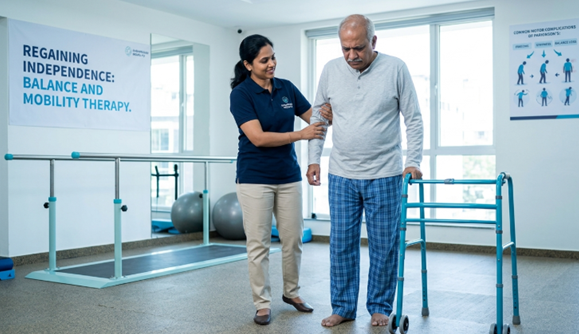
Motor Complications of Untreated Parkinson’s Disease
Bradykinesia, Rigidity, and Falls
Difficulty with Daily Activities
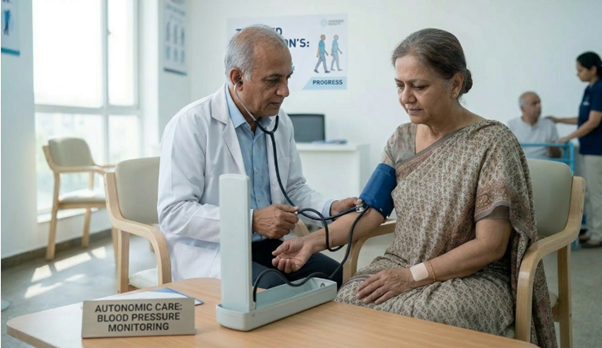
Cognitive and Psychological Complications
Memory Loss and Parkinson’s Disease Dementia
The longer treatment is delayed, the sooner dementia shows up; that’s how untreated Parkinson’s works. Parkinson’s disease dementia occurs earlier than it otherwise would, affecting memory, reasoning, language, and the ability to carry out daily tasks. Depression and anxiety follow the same neurochemical pathway: dopamine loss triggers both, independently of life circumstances. Untreated depression then reduces motivation to exercise, accelerating physical decline.
Autonomic and Sleep Complications
Blood Pressure, Digestion, and Urinary Incontinence
Sleep Disruption
| Sleep Problem | Impact on Patient |
| Insomnia | Worsens all PD symptoms |
| REM sleep disorder | Injury risk; disturbs the household |
| Excessive daytime sleepiness | Unsafe near stairs or while driving |
| Restless leg syndrome | Chronic fatigue and cognitive impairment |
You don’t have to figure this out alone – expert Parkinson’s care is closer than you think. Get started today.
Speech and Swallowing Complications
Many patients withdraw from social life entirely, not by choice, but because communication becomes too frustrating. The voice becomes progressively softer and monotone.
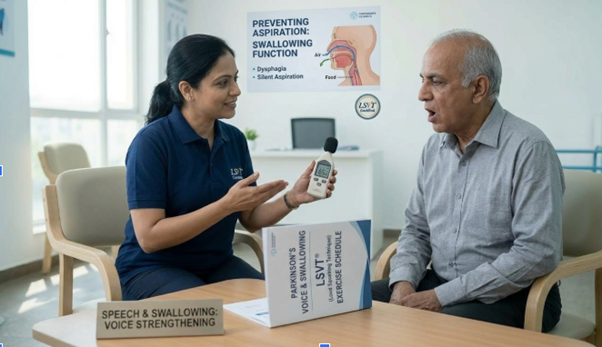
More critically, when swallowing muscles lose coordination, food and liquid enter the airway instead of the stomach, causing aspiration pneumonia, one of the leading causes of death in advanced Parkinson’s. Early speech swallowing therapy dramatically reduces this risk.
“Swallowing difficulties are something we monitor closely in every patient. Caught early, the right therapy can prevent life-threatening aspiration pneumonia.” – Dr. Guruprasad Hosurkar.
Why Early Treatment Changes Everything
Early treatment slows what the disease is trying to accelerate. It protects independence – driving, cooking, daily routines – for far longer. It interrupts postural decline before a fracture happens. And it measurably reduces the risk of depression, dementia, and cognitive decline.
No current treatment reverses Parkinson’s disease. But the gap between treated and untreated outcomes is measured in years of independence.
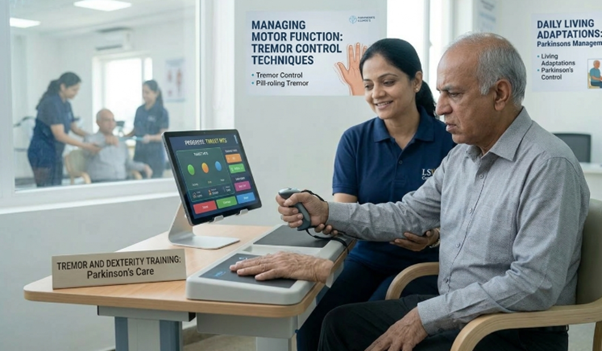
Early Diagnosis and Treatment for Parkinson’s Disease in India
The most important clinical distinction lies in the timing of the tremor. Parkinson’s tremor occurs at rest, whereas essential tremor appears during movement.
Medication
Advanced Interventions: DBS and MRgFUS
- Early medical management stabilises dopamine signalling before significant neuronal loss occurs , giving the brain its best chance to respond to treatment.
- Structured exercise, aerobic training, resistance training, and balance-focused physiotherapy slow disease progression in ways that medication alone cannot.
- Lifestyle modification, consistent sleep habits, a high-fibre diet, stress management, and sustained social engagement address the autonomic and neuropsychiatric dimensions of Parkinson’s that standard care alone frequently misses.
- Deep Brain Stimulation (DBS), when indicated, delivers precise neuromodulation that significantly reduces motor fluctuations, tremor, and rigidity, restoring functional control that medication can no longer maintain.
- MRI-guided Focused Ultrasound (MRgFUS) offers a non-invasive surgical alternative, particularly effective for tremor-dominant Parkinson’s, delivering meaningful symptomatic relief without a single incision.
- When considered early and applied appropriately, both DBS and MRgFUS do more than manage symptoms; they interrupt the trajectory of functional decline that undertreated Parkinson’s consistently produces.
Rehabilitation and Lifestyle
- Physiotherapy, mobility, balance, and fall prevention
- Occupational therapy , safer home environments, and daily independence
- Speech therapy , vocal strength, and aspiration prevention
- Neuropsychological support , cognitive decline, depression, anxiety
Regular aerobic exercise, a high-fibre diet, consistent sleep habits, and social engagement all slow progression in measurable ways. These are part of the treatment, not optional extras.
FAQs
What happens if Parkinson’s disease is left untreated?
Can untreated Parkinson’s disease lead to dementia?
How fast does Parkinson’s disease progress without treatment?
Can early treatment slow the progression of Parkinson’s disease?